First off, I'd like to thank all of you who have taken the time to read my blog over the past few years. It started out with a desire to comment on current news and events from a historical perspective, and shifted into a focus more on permaculture and living a more self-sufficient lifestyle. Work-related demands over the past several months precluded regular posting to this site, and it unfortunately atrophied over time.
Now I'm back and will be on a consistent basis over the coming weeks, months, and hopefully years. My writing will still focus on permaculture and self-sufficiency, but will no longer be taking place via blogger. The dedicated domain for my blog can be found at: http://betterlivingthroughpermaculture.com. There, I will not only provide a forum for discussing basic implementation of the permaculture ethics and principles. I will also showcase my own permaculture projects, from the conceptual stage through implementation, in the hopes that my efforts (both successes AND failures) will inspire and inform you to embark upon the permaculture revolution yourself. I hope to see you there.
I also encourage you to check out our Facebook page, "Better Living Through Permaculture," for updates to the site and discussion, and you can find us on Twitter through @PermieChris. You can also email me at chris@betterlivingthroughpermaculture.com.
Thursday, January 19, 2012


Friday, August 19, 2011
The Problem is the Solution -- Permaculture as a whole-life approach
In previous posts we have explored some of the tools that I use to work toward that better life. While I certainly appreciate everything that I have learned from many of the podcasts that I have listened to and websites I have read over the past several years, I often walk away from them with the feeling that the people behind them know so much more about what they're doing than I do, because they never talk about their mistakes.
Rest assured, I have made plenty of mistakes in my life, and I never want any of my readers to operate under the assumption that I don't make mistakes. I've made a ton of them, I continue to make them, and once I learned to not live in fear of those mistakes and instead embrace them as a learning opportunity, I found them to be a valuable tool on my journey toward that better life. In that spirit, this post is going to explore the process by which I came to where I am now, and how I learned to embrace the problems I encountered as potential solutions to my want for a better life.
The "Anti-Approach"
My views in adolescence and young adulthood were generally formed by what I was against, as opposed to the things that I wanted. An outlook founded in negativity like that plays both the victim and the crutch -- you don't take an active role in a lot of things, and the innate unfairness of the imperfect world offered excuses for that failure to take that active role. This passiveness meant I didn't spend enough time developing my own skills and abilities -- whether those skills or abilities were concerned with my workaday life or something else.
It was this demand that an imperfect world be set right and made fair that led me into the world of left-wing political activism. I jumped right in with a movement whose name probably fit my outlook better than any other -- the "anti-globalization" movement. While I still believe that there are many injustices that exist in the world, now I also know that they can only be fixed from the ground-up as individuals and members of our communities. Back then I thought that only if we got the right policies installed from above, all of our problems as a society (and, admittedly, an individual) would melt away.
About nine to ten years ago I stumbled upon the topic of peak oil, and like many people who stumble upon that topic, suddenly felt like my entire world was turning upside down. Where before I was passive, now I became impulsive. I set about to change just about every aspect of my life in response to the overwhelming sense of foreboding that peak oil (and often with predictable results). I changed my career track and went back to full-time college studies to become a history teacher. My wife and I sold our condo and bought a house at the peak of the real estate bubble (though at least we had the sense to get a fixed term with 20% down). Within two years I was struggling to find full-time teaching work, we were underwater on a house that hung around our neck like a millstone, and my marriage was suffering under the strain. Like I said earlier -- predictable results.
Falling back into old habits was too easy at this point. I blamed the unfairness of the world for my troubles, and this blame in turn absolved me from action. Except this time, there was no economic boom and opportunities did not fall in my lap as they once had. This was difficult for me to deal with, stuck as I was in those old habits -- but eventually (and with the unbelievable support of my wonderful wife) I was able to break most of them. One of the biggest keys in this transformation was permaculture. It's ethical system provides a blueprint not just for how to produce your food, but how to live your life.
The Problem is the Solution
If I had been able to keep a full-time teaching position, I likely would never have opened to the amazing changes that can happen through permaculture and the "active living" model it demands from you. Permaculture teaches us that the world has bounty, and that by just taking responsibility for the earth, ourselves, our children and our neighbors, we can discover this bounty. Even someone with as negative an outlook as me cannot help but feel positive when looking at things from a permaculture perspective. Life may be even more grossly unfair than before, things may in many ways be looking down, but I still can't help but feel content with where I am right now and confident that I'm developing the tools to lead me to that better life.
One example of this outlook is the way I view the 3-hour (or more) round trip commute I have every day to New York City. While part of my plan is to have employment that allows me to be more available to my children and wife and a long commute doesn't accomplish that, it does give me valuable time alone for thinking and learning. I take a little mp3 player with me in the car and listen to podcasts about topics I'm interested in -- permaculture, homesteading, economics and finance, food preparation, history and social trends. This time alone every day had the potential to be a positive -- it was no longer a negative to be resented.
Another example is the way I view my job itself. I count myself extremely fortunate to have found employment in times that are difficult for so many. At the same time, my job is not something that I'm required to get fulfillment from. It's something that I trade my time for in order to get money. In the world we live in (regardless of what it looks on the other side of our numerous unfolding crises) money can help solve a lot of problems and the more that I can do to pay down debt, save, and invest in household production and resiliency, the more I'm taking responsibility for the earth, myself and my family.
I feel a definite sense of responsibility to my job. I also have a sense of responsibility to my family. I know which one is the greater responsibility, which helps me to set limits on demands to my time. I don't apologize for not being able to stay late without notice (except in the event of a real emergency), nor do I feel guilty about using my vacation time. The funny thing is that none of these traits hurt me in the work world -- they help me to stay grounded and sane instead of burning out. More importantly I'm able to spend those precious, fleeting moments with my kids while they grow up -- a few more now, a lot more as part of my better life.
Conclusion
My point in this post is this: if an underachiever like me can make such sweeping and positive changes toward creating that better life, then surely you can too. I still make just as many mistakes as before -- if not more -- except for now they're a lot more part of the observation process. I learn from them. I move on and apply them without guilt. Or at least I try on that last part, and have been getting better the more that I've tried. Living by permaculture is not a complicated method to follow, but it is difficult, and increases in difficulty the further you get away from it.
Don't stay away from applying permaculture to your life. Start applying it now. If you're patient, you can see a marked difference in both your motivation to have a better life but also the way you actually live. I know I have!
Rest assured, I have made plenty of mistakes in my life, and I never want any of my readers to operate under the assumption that I don't make mistakes. I've made a ton of them, I continue to make them, and once I learned to not live in fear of those mistakes and instead embrace them as a learning opportunity, I found them to be a valuable tool on my journey toward that better life. In that spirit, this post is going to explore the process by which I came to where I am now, and how I learned to embrace the problems I encountered as potential solutions to my want for a better life.
The "Anti-Approach"
My views in adolescence and young adulthood were generally formed by what I was against, as opposed to the things that I wanted. An outlook founded in negativity like that plays both the victim and the crutch -- you don't take an active role in a lot of things, and the innate unfairness of the imperfect world offered excuses for that failure to take that active role. This passiveness meant I didn't spend enough time developing my own skills and abilities -- whether those skills or abilities were concerned with my workaday life or something else.
It was this demand that an imperfect world be set right and made fair that led me into the world of left-wing political activism. I jumped right in with a movement whose name probably fit my outlook better than any other -- the "anti-globalization" movement. While I still believe that there are many injustices that exist in the world, now I also know that they can only be fixed from the ground-up as individuals and members of our communities. Back then I thought that only if we got the right policies installed from above, all of our problems as a society (and, admittedly, an individual) would melt away.
About nine to ten years ago I stumbled upon the topic of peak oil, and like many people who stumble upon that topic, suddenly felt like my entire world was turning upside down. Where before I was passive, now I became impulsive. I set about to change just about every aspect of my life in response to the overwhelming sense of foreboding that peak oil (and often with predictable results). I changed my career track and went back to full-time college studies to become a history teacher. My wife and I sold our condo and bought a house at the peak of the real estate bubble (though at least we had the sense to get a fixed term with 20% down). Within two years I was struggling to find full-time teaching work, we were underwater on a house that hung around our neck like a millstone, and my marriage was suffering under the strain. Like I said earlier -- predictable results.
Falling back into old habits was too easy at this point. I blamed the unfairness of the world for my troubles, and this blame in turn absolved me from action. Except this time, there was no economic boom and opportunities did not fall in my lap as they once had. This was difficult for me to deal with, stuck as I was in those old habits -- but eventually (and with the unbelievable support of my wonderful wife) I was able to break most of them. One of the biggest keys in this transformation was permaculture. It's ethical system provides a blueprint not just for how to produce your food, but how to live your life.
The Problem is the Solution
If I had been able to keep a full-time teaching position, I likely would never have opened to the amazing changes that can happen through permaculture and the "active living" model it demands from you. Permaculture teaches us that the world has bounty, and that by just taking responsibility for the earth, ourselves, our children and our neighbors, we can discover this bounty. Even someone with as negative an outlook as me cannot help but feel positive when looking at things from a permaculture perspective. Life may be even more grossly unfair than before, things may in many ways be looking down, but I still can't help but feel content with where I am right now and confident that I'm developing the tools to lead me to that better life.
One example of this outlook is the way I view the 3-hour (or more) round trip commute I have every day to New York City. While part of my plan is to have employment that allows me to be more available to my children and wife and a long commute doesn't accomplish that, it does give me valuable time alone for thinking and learning. I take a little mp3 player with me in the car and listen to podcasts about topics I'm interested in -- permaculture, homesteading, economics and finance, food preparation, history and social trends. This time alone every day had the potential to be a positive -- it was no longer a negative to be resented.
Another example is the way I view my job itself. I count myself extremely fortunate to have found employment in times that are difficult for so many. At the same time, my job is not something that I'm required to get fulfillment from. It's something that I trade my time for in order to get money. In the world we live in (regardless of what it looks on the other side of our numerous unfolding crises) money can help solve a lot of problems and the more that I can do to pay down debt, save, and invest in household production and resiliency, the more I'm taking responsibility for the earth, myself and my family.
I feel a definite sense of responsibility to my job. I also have a sense of responsibility to my family. I know which one is the greater responsibility, which helps me to set limits on demands to my time. I don't apologize for not being able to stay late without notice (except in the event of a real emergency), nor do I feel guilty about using my vacation time. The funny thing is that none of these traits hurt me in the work world -- they help me to stay grounded and sane instead of burning out. More importantly I'm able to spend those precious, fleeting moments with my kids while they grow up -- a few more now, a lot more as part of my better life.
Conclusion
My point in this post is this: if an underachiever like me can make such sweeping and positive changes toward creating that better life, then surely you can too. I still make just as many mistakes as before -- if not more -- except for now they're a lot more part of the observation process. I learn from them. I move on and apply them without guilt. Or at least I try on that last part, and have been getting better the more that I've tried. Living by permaculture is not a complicated method to follow, but it is difficult, and increases in difficulty the further you get away from it.
Don't stay away from applying permaculture to your life. Start applying it now. If you're patient, you can see a marked difference in both your motivation to have a better life but also the way you actually live. I know I have!
Tuesday, August 9, 2011
Getting the Skills to Pay the Bills (or avoid them altogether)
In the last post on this blog, we looked at the core concepts of Your Money or Your Life, and how they help to transform your relationship with money. Like the system of permaculture, YMOYL is an ethical system that is based on some core values. In fact, the values of permaculture and YMOYL can almost completely overlap each other. Both are concerned with wise use of surplus, especially -- after all, financial independence is next-to-impossible without accumulating some level of financial surplus.
In this post we're going to delve a little deeper into how to accumulate that financial surplus, focusing on the subject of skills. I have become convinced that gaining a true measure of independence is dependent upon developing a broad set of skills that increase your self-reliance while decreasing your reliance on outside products and service providers -- and the money that you have to trade your time for in order to pay them.
Defining "Skills"
There are some pretty significant economic benefits to skills that we will delve into a little bit later. First, I would like us to just get a solid definition along with some basic examples. A skill is any kind of knowledge or training that enables you to become a producer instead of a consumer. So far on this blog, we have delved into three important skills for any self-reliant homesteader: gardening, cooking and food preservation. By integrating these three skills into one system -- growing fresh heirloom tomatoes and herbs; processing and cooking my own tomato sauce with basil, oregano and garlic; and canning that sauce in order to put it up on my basement shelves for the winter -- I have helped to make my household more self-reliant. (Did I mention that I also compost the seeds and skins left from the tomatoes, "closing the loop" by turning my "waste" into valuable compost for next year's garden?)
Some other skills that I've picked up over the years include: basic bicycle repair and maintenance, changing the oil in my own automobile, basic carpentry, and map reading / navigation. This is by no means an exhaustive list, and some of the skills listed may seem rather rudimentary (such as changing my own automobile oil), but they are all important because they help to increase my own self-reliance, while simultaneously reducing my reliance on outside people and systems to provide those services for me. My skills at basic carpentry and electrical installation literally saved our family thousands of dollars when we remodeled our house shortly after we closed on it and moved in.
More than just saving money
Skills save us money in the immediate term, but their benefits go far beyond that. One of the benefits of broadening our skill set as opposed to purchasing items and services with money (that we trade our life energy for), is that by learning a skill you often learn a process for doing something. What differentiates processes from products is that often time the former cost very little to get, and once you have them they don't go away and no one can take them away from you. Products and outside services, on the other hand, must be continually replenished after they are used up. The most common means of replenishment is to exchange money (in reality, life energy) for them.
Looking at our skills through this lens provided by YMOYL (money = life energy) is very useful for putting this into perspective. For example, many friends and members of my family (more on my wife's side) express amazement at how I am able to find the time to maintain my garden. And I will admit that all of my home food production activities and processing take some serious time. However, I also know that I seriously cut our home food bill through these activities, creating a greater financial surplus for investment. Eating fresh, wholesome food raised without chemical fertilizer or pesticides increases our family's health. In the long run, the garden actually saves me time, because it contributes toward my long-term goal of financial independence. In another few years, when I have reached the point at which I can step away from having to work for someone else and truly live the life that I want, many (if not all) of the people who don't see how I can find the time to garden will still be stuck on the same hamster wheel of exchanging their life energy for money to pay for the products and services they need and want.
Another benefit of developing skills is the opportunity for self-employment. For example, part of my longer-term plan is to develop a small business line where I help people to establish home vegetable gardens or even maintain them throughout the season. One example of this kind of business is Suburban Farming Company, LLC in the Philadelphia, PA area. Another kind of business along these lines I have read about (sorry, no link immediately available on this one) is where people essentially run a farm through developing sizable gardens at the homes of those who want fresh produce but either can't or don't want to deal with the work, and then take the surplus for market sale. While neither of these models likely provide enough income to support a household by themselves, the skills I have developed in permaculture and gardening nevertheless provide opportunities for some income along these lines.
Conclusion
Developing and broadening our skill set helps save money not by necessarily increasing our income (at least in the short run), but by avoiding expenses altogether by relying on ourselves. Skills are something that, once we get them, stay with us for life and cannot be taken away. They help us move along that path to self-reliance instead of reliance on people and systems we cannot control. I urge all of you to take a look at the skills that you have and figure out how you can use them to increase your own freedom and self-reliance. Also, use skills as a means of increasing community with those around you by sharing them with your neighbors -- and maybe picking some up from them in the exchange.
As always, I invite you to share your thoughts on this post in the comments below. And, if you like this kind of thing, please forward it along to your friends.
Tuesday, August 2, 2011
"Your Money and Your Life" -- Permaculture for Your Finances
Now that I've covered some of the basics of my gardening and food processing methods, it's time to turn to the subject of home finances. Financial well-being is just as key to my drive toward self-reliant freedom and community living as gardening is, perhaps even more so. But with the overwhelming number of financial self-help gurus out there like Dave Ramsey, Suze Orman and Robert Kiyosaki, to name only a few, finding an approach that works can seem daunting. Now, I'm not going to say that you should definitely go with one method over all others -- the most important thing is to look at as many different sources as possible and find what works best for you, and then stick with it. For me, though, there is one book on home finances that stands head-and-shoulders above the rest: Your Money or Your Life by Joe Dominguez and Vicki Robin (abbreviated from here on as YMOYL).
YMOYL, like many practical financial self-help manuals out there, emphasizes the elimination of debt as a central concept of financial well-being. The end goal is something the authors call "Financial Independence," or "FI" for short. What sets it apart is that it actually affects a wholesale transformation of the way that you view money in your life -- kind of like a form of financial permaculture. By changing the way that you view money on the most basic and profound level, you free yourself from being controlled by it and instead controlling the way that it affects you. Central to this transformation is the concept of "life energy".
Life Energy -- the core of YMOYL
Here's how it works. The "big view" of money -- like looking down on earth from a spaceship many miles above the earth, as Robin and Dominguez describe it -- is that it is just another force in the world that ebbs and flows, much like the tides of the ocean. You have periods in your life where more money flows in, and others where more flows out. No matter what, it is always moving, changing hands. In the realm of personal finance, there is not some finite amount of money that will ever flow into your life.
But you are born with one substance in finite supply: time. No matter what, each and every one of us is born with a finite amount of time in our life, an account that will never replenish, but instead will just be drawn upon until emptied. When comparing and contrasting these two resources, which then should have a greater sense of urgency -- the one that can ebb and flow over time, or the one that moves linearly toward a definitive end? When placed in those terms, the answer should be clear. Time is the resource that we should treat with more care and concern.
That's all well and good as a philosophical concept, but how do you put it into practice? We all have bills to pay after all, and time doesn't exactly pay the bills. Or does it? Joe Dominguez came up with a way to show that it did -- and it is this simple but profound changing of our vantage point that is the basis to the entire YMOYL program. When we go to our jobs or engage in paid employment, we are exchanging our time -- our life energy, as it were -- for money.
Let me say that again to re-emphasize the importance of it. When we go to work for pay, we are exchanging our life energy for money.
Dominguez even came up with a way of measuring this life energy. You start with the net amount of pay you receive, after all taxes are taken out. Then, total up the amount of money you spend on things related to your job -- gas and tolls for commuting, work clothes that you wouldn't otherwise get, lunches out at work, dinners out because you're too tired to cook when you come home, entertainment and recreation costs to "decompress" from the work day, etc. Don't hold anything back, and when you're done, take that number and subtract it from your net pay. This is your real income.
Then, total up the amount of time you spend directly on your job and also related to your job. Include your daily commute time, time you spend shopping for work-related clothes and gear, recreation time to relax after work, etc. This is the real time you spend on your job. Then, take your real income and divide that by your real time, and the result is your real hourly wage. If you are honest about this activity, then you will end up with a real hourly wage that is far below what you thought you were being paid. This represents the amount of money that you actually receive in exchange for your life energy.
As an example, at the time I figured this out last year my hourly rate as an engineer was over $40 per hour. When I figured out my real hourly wage, after my significant commuting expenses and 3 hour daily round-trip were taken into account, I ended up with a real hourly wage of around $11.50!
So now that we have this figure, what do we do with it?
The Process
Since money is something that we simply exchange our life energy for, and our life energy is our most precious and finite resource, then it stands to reason that we should be very conscious about how we use our money. Dominguez has another simple approach to maximize our consciousness about money: you track every cent that comes in and out of your life. Yes, he meant that literally -- every single cent. Just think about it as running your household finances in the same way that you would manage a business. If you keep sloppy books and lose track of money regularly chances are that your business won't do too well. Conversely, if you keep meticulous track of inflows and outflows, you better your chances at success.
Instead of binding yourself to a strict budget, like many other plans (such as Dave Ramsey's) do, YMOYL actually works in a kind of "reverse budget" process. You take all of those expenses that you have recorded for the month, and divide them into the appropriate budget categories. Then, you have a clear picture of how much you are really spending and what you're spending it on. Be prepared for some surprises here -- a daily $5 latte habit that doesn't seem like much day-to-day takes on new significance when you find that it really costs you over $100 per month. But no matter what, when you go through this exercise don't allow yourself to feel guilty. The goal is to gain a clear assessment of your finances, not to make emotional judgments about them.
Now we get to the point where the real transformation takes place. You take your real hourly wage, and divide it into the dollar figure that you arrived at for each spending category. The number you get as a result is the number of hours of life energy that each one of those categories costs you for the month. Instead of looking at your expenses in terms of money, you see them in terms of a much more important resource -- the finite amount of time that you have on this earth. As I have moved along this path, I even found myself judging possible purchases in terms of whether that expenditure is worth the amount of life energy I have to devote toward it. The impact of this change in perspective is that your spending diminishes naturally. You don't have to feel like you're confining your spending by a budget straitjacket -- something that often turns out to be as successful as a crash diet. Instead, you're looking at your expenditures through the lens of whether or not they bring you a measure of fulfillment equal to or greater than the amount of your life energy that you devote toward acquiring it.
Conclusion
This is only an introduction to YMOYL, but I think it's important to focus on the way that it can transform your relationship with money. Instead of viewing it as a source of stress, you can see it for what it is -- a medium of exchange to be used in ways of your choosing to achieve personal fulfillment and financial freedom. This is the reason that I call YMOYL "financial permaculture" -- it guides you to work in concert with systems that already exist rather than fighting against them, instead looking for ways to make those systems work more efficiently in your favor.
Specifics on how to get those systems to work in your favor, as well as the remainder of the YMOYL approach, are the topic of other posts to come. Now at least your have the basic building blocks (as well as the link to the YMOYL website, above) to start on your own journey toward that better life!
As always, I invite you to share your thoughts on this post or approaches toward personal finance and home economics that work for you. And if you find that you find some value in it, pass it along to your friends.
YMOYL, like many practical financial self-help manuals out there, emphasizes the elimination of debt as a central concept of financial well-being. The end goal is something the authors call "Financial Independence," or "FI" for short. What sets it apart is that it actually affects a wholesale transformation of the way that you view money in your life -- kind of like a form of financial permaculture. By changing the way that you view money on the most basic and profound level, you free yourself from being controlled by it and instead controlling the way that it affects you. Central to this transformation is the concept of "life energy".
Life Energy -- the core of YMOYL
Here's how it works. The "big view" of money -- like looking down on earth from a spaceship many miles above the earth, as Robin and Dominguez describe it -- is that it is just another force in the world that ebbs and flows, much like the tides of the ocean. You have periods in your life where more money flows in, and others where more flows out. No matter what, it is always moving, changing hands. In the realm of personal finance, there is not some finite amount of money that will ever flow into your life.
But you are born with one substance in finite supply: time. No matter what, each and every one of us is born with a finite amount of time in our life, an account that will never replenish, but instead will just be drawn upon until emptied. When comparing and contrasting these two resources, which then should have a greater sense of urgency -- the one that can ebb and flow over time, or the one that moves linearly toward a definitive end? When placed in those terms, the answer should be clear. Time is the resource that we should treat with more care and concern.
That's all well and good as a philosophical concept, but how do you put it into practice? We all have bills to pay after all, and time doesn't exactly pay the bills. Or does it? Joe Dominguez came up with a way to show that it did -- and it is this simple but profound changing of our vantage point that is the basis to the entire YMOYL program. When we go to our jobs or engage in paid employment, we are exchanging our time -- our life energy, as it were -- for money.
Let me say that again to re-emphasize the importance of it. When we go to work for pay, we are exchanging our life energy for money.
Dominguez even came up with a way of measuring this life energy. You start with the net amount of pay you receive, after all taxes are taken out. Then, total up the amount of money you spend on things related to your job -- gas and tolls for commuting, work clothes that you wouldn't otherwise get, lunches out at work, dinners out because you're too tired to cook when you come home, entertainment and recreation costs to "decompress" from the work day, etc. Don't hold anything back, and when you're done, take that number and subtract it from your net pay. This is your real income.
Then, total up the amount of time you spend directly on your job and also related to your job. Include your daily commute time, time you spend shopping for work-related clothes and gear, recreation time to relax after work, etc. This is the real time you spend on your job. Then, take your real income and divide that by your real time, and the result is your real hourly wage. If you are honest about this activity, then you will end up with a real hourly wage that is far below what you thought you were being paid. This represents the amount of money that you actually receive in exchange for your life energy.
As an example, at the time I figured this out last year my hourly rate as an engineer was over $40 per hour. When I figured out my real hourly wage, after my significant commuting expenses and 3 hour daily round-trip were taken into account, I ended up with a real hourly wage of around $11.50!
So now that we have this figure, what do we do with it?
The Process
Since money is something that we simply exchange our life energy for, and our life energy is our most precious and finite resource, then it stands to reason that we should be very conscious about how we use our money. Dominguez has another simple approach to maximize our consciousness about money: you track every cent that comes in and out of your life. Yes, he meant that literally -- every single cent. Just think about it as running your household finances in the same way that you would manage a business. If you keep sloppy books and lose track of money regularly chances are that your business won't do too well. Conversely, if you keep meticulous track of inflows and outflows, you better your chances at success.
Instead of binding yourself to a strict budget, like many other plans (such as Dave Ramsey's) do, YMOYL actually works in a kind of "reverse budget" process. You take all of those expenses that you have recorded for the month, and divide them into the appropriate budget categories. Then, you have a clear picture of how much you are really spending and what you're spending it on. Be prepared for some surprises here -- a daily $5 latte habit that doesn't seem like much day-to-day takes on new significance when you find that it really costs you over $100 per month. But no matter what, when you go through this exercise don't allow yourself to feel guilty. The goal is to gain a clear assessment of your finances, not to make emotional judgments about them.
Now we get to the point where the real transformation takes place. You take your real hourly wage, and divide it into the dollar figure that you arrived at for each spending category. The number you get as a result is the number of hours of life energy that each one of those categories costs you for the month. Instead of looking at your expenses in terms of money, you see them in terms of a much more important resource -- the finite amount of time that you have on this earth. As I have moved along this path, I even found myself judging possible purchases in terms of whether that expenditure is worth the amount of life energy I have to devote toward it. The impact of this change in perspective is that your spending diminishes naturally. You don't have to feel like you're confining your spending by a budget straitjacket -- something that often turns out to be as successful as a crash diet. Instead, you're looking at your expenditures through the lens of whether or not they bring you a measure of fulfillment equal to or greater than the amount of your life energy that you devote toward acquiring it.
Now, you move to the point at which you make judgments on your expenditures -- but it is a value-based judgment, not an emotional one. YMOYL provides three questions to guide you in this process:
1. Did I receive fulfillment, satisfaction and value in proportion to life energy spent?
2. Is this expenditure of life energy in alignment with my values and life purpose?
3. How might this expenditure change if I didn’t have to work for a living?
Analyze each expense category with each question individually. If you could receive more fulfillment by spending more in any category according to that question, mark it with a +. If you are where you want to be, mark it with a 0. If you could achieve more fulfillment by reducing that expenditure, mark a -. This exercise is not about guilt, it's about honesty -- honesty in the pursuit of finding that better life, one that brings you personal fulfillment.
Conclusion
This is only an introduction to YMOYL, but I think it's important to focus on the way that it can transform your relationship with money. Instead of viewing it as a source of stress, you can see it for what it is -- a medium of exchange to be used in ways of your choosing to achieve personal fulfillment and financial freedom. This is the reason that I call YMOYL "financial permaculture" -- it guides you to work in concert with systems that already exist rather than fighting against them, instead looking for ways to make those systems work more efficiently in your favor.
Specifics on how to get those systems to work in your favor, as well as the remainder of the YMOYL approach, are the topic of other posts to come. Now at least your have the basic building blocks (as well as the link to the YMOYL website, above) to start on your own journey toward that better life!
As always, I invite you to share your thoughts on this post or approaches toward personal finance and home economics that work for you. And if you find that you find some value in it, pass it along to your friends.
Saturday, July 30, 2011
Tomato Sauce -- First Batch of 2011
I finally had enough Amish Paste and Juliet tomatoes to make this season's first batch of sauce today. This is the first year that I'm using an Italian tomato press for making sauce, and I have to say that it makes the task much, much easier than skinning tomatoes and de-seeding them by hand!
The press that I got is a Roma food strainer & sauce maker that I purchased from Weston Supply for around $65 including tax and shipping. The order also included a bonus 4-piece accessory kit of different strainers that allow me to process just about any kind of soft fruit, vegetable or berry with it. If today was an indication of how much value I'm going to get out of this thing, then I have to say that it will be worth every penny several times over. The only complaint I have with it so far is that the strainer wanted to rotate around the suction-cup base as I was turning the crank, but that could also be due to putting a light coating of oil on the rubber to help it stick better. Next time I'll just do it dry and see if it eliminates the problem.
Here's a picture of the tomato press with the hopper full of quartered tomatoes. You press the tomatoes down into the hopper with the red plunger sitting on top, then by turning the crank a screw inside of the press forces them through the first strainer. The threads on the screw get smaller the further out they go, and the diameter of the strainer gets smaller at the same time, so it pushes out all of the juice and even a good bit of pulp, which flows down the chute into the bowl on the right. The skins, seeds and remainder of the pulp get spit out the end and into the second bowl. You definitely lose some pulp this way, but for the amount of work it saves it's well worth it.
 |
| Roma brand Food Strainer and Sauce Maker, filled and ready to process |
And here's me and my #1 helper for all things gardening -- my four year old daughter. It's amazing to me how much she wants to help me with everything I do. All I have to do is disappear into the garden and she'll find me within 5 minutes, wanting to be let in the gate, wanting to help me pick whatever is ready. In case you're wondering about the outfit, she's getting ready to head out to her gymnastics class right as I was processing the tomatoes -- but she wouldn't be satisfied if she couldn't turn the crank on the press! I guess this all shows another benefit of gardening -- it provides a productive activity that parents and children can do together.
 |
| Daddy and daughter time -- there's nothing like it! |
Finally, here's the final product ready to be cooked down in a stock pot. I put in some fresh oregano and basil leaves, along with a little bit of olive oil, and it will take most of the day to cook down into sauce. I'll probably lose close to half of the volume, but that will only concentrate the flavor. After that, I'll can it in mason jars using a hot water bath, label it with some masking tape and a Sharpie marker, and put it up on the shelf to save for the winter. During the summer we don't use much sauce, preferring instead to just stew mixed vegetables in a white wine and garlic base for over our pasta.
 |
| Ready to cook down |
Even if you don't have a garden for fresh tomatoes and herbs, you can always pick them up from local farms and farmers' markets. Look for "seconds" that might be slightly bruised or almost past the point of ripeness to get a better deal. If you have a tomato press, there's no reason you can't make sauce like this. Homemade tomato sauce also makes a great gift for friends over the winter -- I can guarantee that most people will appreciate it much more than another bottle of store-bought wine!
As always, your comments are welcome and, if you like this sort of thing, please take a moment and pass it along to your friends. Thanks!
Thursday, July 28, 2011
Permaculture as a key to my Better Life
Five years ago, I started out as a beginning gardener, armed with a copy of Mel Bartholemew's Square Foot Gardening and my mother's accumulated wisdom from a lifetime of practicing the craft. But gardening really is a gateway drug -- it's bound to lead to stronger stuff, if you delve past its surface. The past year or so has opened me up to the great world of permaculture, a different system of producing food and, ultimately, organizing your life. It is about learning to produce more while consuming less, freeing up ample time to share with your family, friends and community. If you're not really familiar with permaculture, read on and I'll share an overview, as well as why and how I integrate it into my life.
An Ethical System
One of the things that drew me to permaculture is that, although engaging scientific methods of hypothesis, trial and observation, it is at its heart guided first by an ethical code. This allows its practitioners to approach the world from a more holistic and less reductionist starting point. Masanobu Fukuoka, author of The One Straw Revolution (a short, wonderful book on what Fukuoka called "natural farming") took this argument even further -- he said that it was really pointless to try and figure out why or really how nature did what it did -- you saved a lot of time if you just focused on what it did. More on that point a little later....
Permaculture's core ethic is, like most things having to do with it, simple in words but extremely complicated in practice. According to Bill Mollison, author of Permaculture: A Designer's Manual the "prime directive" of permaculture is to live a life in which we take responsibility for our lives, and those of our children. There are three additional guiding principles of how to pursue this end:
1. Care for the earth
2. Care for people
3. Minimize consumption of resources
Now, I'm aware that some people may look at that last point and take offense, saying it is in their right to consume what they want. That's anyone's prerogative to look at things that way. However, permaculture actually opens a path to more -- more food, more health, more time to spend with the people you care about. I'll expand on this last point in the final section of this piece.
Mimicking Nature
Permaculture takes its cues from nature. Permaculturalists don't want to control nature, they want to take advantage of the things that it already does much better than we can. The key to this approach is to observe nature and take note of its patterns. For instance, think of an open field coming to a forest's edge. Where is nature the most varied and active in that setting -- in the field, in the forest, or where the two meet and overlap? It's the transition zone that has the most action, the area that permaculture calls "edge". One of the goals in practice is to try and maximize edge throughout your system.
Biological diversity is at its peak in these edges -- therefore that's a condition that we want to embrace and encourage in permaculture as well. We want plants and other life forms, such as fungi, worms and insects to be able to take advantage of some of the natural ways that they help each other. Allow nature to do the work for you.
Observation provides the key to knowing what combinations work and which ones don't. Some of these are counter-intuitive. To revisit Fukuoka, he found that even a blight that commonly took out 20% of his rice crop every year, because it cleared the way for the healthy plants to produce even more while also encouraging stronger seeds for next year's crop -- resulting in harvests that equaled or surpassed those of his chemical-and-petroleum farming neighbors. This brings me to the last, but most important feature of permaculture -- the benefits.
Getting More from Less
Permaculture is about production. For me, it is a tool to use to make my bridge to freedom, because it does more from less -- allowing me to cut loose from reliance on too many outside systems. The term that Mollison and most others use for this is yield.
Yield in permaculture is a greater matter than just how much money you spend in a year compared to how much you make. In line with the third principle (see above), it takes into account resources used. For most of modern farming, this means that petroleum and chemicals have to be considered for their entire production chain. This demonstrates how inefficient our current systems really are. Permaculture, instead of looking for outside inputs, tries to "close the loop" in as many ways as possible. By closing the loop, I mean recycling materials through natural processes so that "wastes", instead of being discarded, instead become useful "inputs" that boost our yields.
We can try to mimic these systems in order to encourage faster development. A healthy soil is key to a good permaculture operation, so we need to do things that encourage healthy soil development and maintenance. Nature has already provided a model -- the forest floor where leaves, limbs and animal carcasses fall to be gradually broken down by the fungi, mold and other organisms into beautiful black humus. A common way of mimicking this process among most serious gardeners is composting. By recycling food waste we are keeping it out of landfills, relying less on oil-fueled trucks to transport them or oil-fueled equipment to build the facility -- and for giving up our "right" to consume all of these resources, we end up with a substance that we can add to our garden soil to increase production. Less in --> more out.
We also want to conserve water. This has been referred to as "making water walk instead of run". If you can slow water down to a speed where it is absorbed into the soil instead of runoff, it means less watering -- and less work. There are some simple ways to do this. One is to dig berms and swales along the contour lines of an area, giving the water nowhere to flow but a large space to sit. As the water sits, it is absorbed into the berm and permeates through it, giving plant roots an opportunity to drink it up. This method has even "greened the desert" next to the Dead Sea -- a place that otherwise looks like a moonscape of rock under a blazing hot sun. Another method is to just dig lots of holes to catch the water, and planting around the hole's edge. (There's that edge again!) My garden is on a slight slope, and what I did was to build unbordered raised beds crossing the slope, allowing the beds to serve as berms and the mulched footpaths between as swales. In any event, I just came out of a couple of weeks of dry, hot (approaching 100) weather in NY while hardly needing to water my plants. I have 15 tomato plants that remained green and vigorous throughout.
Earlier we talked a bit about biodiversity. The most basic method of achieving this is companion planting -- interspersing different vegetables in your garden together. It's what I do, and again the result has been a vigorous and healthy garden with little to no watering under sustained hot, dry conditions. Some permaculturists may take issue with my inclusion of companion planting, but I just see it as a simpler system of guilds. Guilds are where you randomly mix groups of plants together (literally tossing mixed seed onto the ground in some instances), preferably at least some perennials, in order to take advantage of symbiotic relationships between the plants. I'm not there yet, but companion planting is a simpler step along that path.
I certainly don't claim to be an expert on permaculture, and I readily admit that I'm a novice. But that's the great thing about permaculture, it's a long, patient process so it's more important to just jump in and see what happens. I still kill a lot of plants (the difference between an experienced and unexperienced gardener is just the greater number of plants that the former has killed compared to the latter). But I have seen my overall yields rise while reducing the time that I have to spend weeding and watering. A large part of the permaculture approach is embracing inaction at times -- "no work farming," Fukuoka called it -- which is extremely difficult when it comes to leaving some of the weeds in my garden beds to help hold in moisture, reduce temperature and create a habitat for predatory insects. But I'm learning, improving and OBSERVING over time.
I hope this short treatise on permaculture has given you a workable overview (and some good links), as well as a view into the workings of my overall path "to that better life". I also welcome contributions to the discussion, as they offer me a chance to learn from you, the reader -- leave a comment below and forward it to a friend!
Tuesday, July 26, 2011
Striving for that Better Life
In order for any self-directed enterprise -- take, for example, a blog -- to be successful, it has to be about our passions, those things in life that really drive us. For the past two-and-one-half years I have dabbled with this blog on and off, and I have often attributed the failure to really get it off the ground to the numerous demands that life has thrown my way. I have two young children, a demanding job with a 3-hour daily commute, and homesteading activities such as a large vegetable garden and countless home projects, so to make that assessment really isn't much of a reach.
Except, while that may be true now and for the past year, when I started this blog I was not employed full-time and we had only one child. There are many real reasons for not getting this project off the ground, but foremost among them is that I haven't really engaged my passions with this blog on a consistent basis. It has primarily been a vehicle for commenting about current trends and events, scattered news articles and the like. The internet is full of this kind of commentary, and while I like to think that my perspective on these things is special, the reality is that it is not. Especially when that commentary is almost the sole purpose of this blog.
So, this post marks a turning point in the purpose of this venue. The primary themes that this blog will deal with from now on are: gardening and permaculture; alternative, home-based energy; home economics and household production; and historical trends and examples of those themes. I refer to these themes as the keys to "striving for that better life." They are the true passions in my life, the things of which I can never tire from discussing, and the new focus of this blog.
What is my vision of this "better life"? It is a simple life filled with bountiful simple pleasures. It is a life where I am able to spend considerable time with my wife, daughter and son. It means being involved as a contributing member to my community. It means being engaged in meaningful, purposeful, productive work on a daily basis. It means paying down debt, gradually but drastically reducing expenses, learning new skills and saving capital so that we are no longer dependent upon outside systems such as employers, utility companies, agribusiness and government for the things we need.
The better life I am striving for is one that is my own definition of freedom for myself and my family. Your definition of a better life may share some of these things in common, or it may be drastically different. Not only is that OK, it is the way that things should be. As one of my influences in this shift in focus, Jack Spirko of The Survival Podcast has frequently said, freedom (or, as he calls it, liberty) is something that each of us defines for ourselves. Since I've shared with you my short definition of freedom, I'd be interested to learn how you define it, because you might just help me to realize an aspect of it that I hadn't thought of before.
So, from here on out, this blog will not be simply observations of the world and news around me. It will be about getting grease and dirt under my fingernails and streaked across my face, as well as sawdust in my hair. It will be closer to the way that I live my life now, sharing the journey with you, dear reader, toward that better life -- in fits, starts and setbacks. We will also showcase and discuss the stories of people engaged in these kinds of activities and trying to live that "better life". Many of them are far more advanced in their progress than you or I, but that makes them serve as examples to all of us as to what is possible. I'll also look at these efforts through the lens of history, hopefully helping us to realize that nothing we are talking about here is really all that new -- much of it came under the heading of "common sense" to our grandparents and great-grandparents.
If you're interested in these kinds of things, tell your friends. Spread the word. Come along with me for the journey and the conversation. Together, we can all strive to build that better life -- for ourselves, our families, our communities and each other. Let's do it!
Friday, March 18, 2011
Links 3/18/2011
Japan and the Economy: What You Need to Know (by Daniel Gross, Yahoo! Finance): A typically misleading mainstream media article on the potential impact of Japan's crisis on the US economy. Most telling is how the article does not even mention the fact that Japan is a significant buyer of US Treasuries, currently holds some $800 billion in them, and will likely not only have to stop buying them but sell off their stock in order to finance reconstruction. Also no mention of the way that Japan will likely begin importing significantly higher quantities of diesel in order to keep their lights on, thus pushing even higher demand on an oil market that already is stretched to its production limits.
The Vegetarian Myth (interview with Lierre Keith on Peak Moment Television): Interview with a former vegan on the myths of vegetarianism, specifically that it is a lifestyle that decreases violence by reducing harm to animals, when agriculture has proven to be one of the most biologically destructive processes ever designed by man. If you doubt this point, just look at the current condition of the so-called "Fertile Crescent" where agriculture began. Other points in this discussion will be the likely focus of a future post.
When the Lights Go Out (by Ashvin Padurangi, The Automatic Earth blog): Contrast this view with the Yahoo! Finance article above. I tend to take something more seriously when it doesn't ignore energy -- the lifeblood of the global industrial economy.
George Will: Driving a Wedge (by Don Plummer, The Trillium Patch, accessed on Energy Bulletin): I honestly didn't even bother to read the original Newsweek piece by Will cited in this article, but I'm all for anything that points George Will out as the fatuous gasbag that he truly is. Having lived in Westchester County and commuted by train daily, I can state with pretty reasonable confidence that many traveling via rail had a conservative perspective, and that they didn't see the train schedules as leading to any kind of "collectivism." It's probably more likely that they, like me, found the train to be a comfortable and convenient means of transportation.
The Limits of Incantation (by John Michael Greer, The Archdruid Report, accessed on Energy Bulletin): Greer describes how Americans seem to believe that incantation can relieve us from our current and future predicaments surrounding the availability of cheap, dense energy. It seems to mirror some of the things that I wrote about in a recent post, American Ignorance on Energy, Part One, as well as a much older post (and one of my own personal favorites), The Myths of Historical Positivism.
The Vegetarian Myth (interview with Lierre Keith on Peak Moment Television): Interview with a former vegan on the myths of vegetarianism, specifically that it is a lifestyle that decreases violence by reducing harm to animals, when agriculture has proven to be one of the most biologically destructive processes ever designed by man. If you doubt this point, just look at the current condition of the so-called "Fertile Crescent" where agriculture began. Other points in this discussion will be the likely focus of a future post.
When the Lights Go Out (by Ashvin Padurangi, The Automatic Earth blog): Contrast this view with the Yahoo! Finance article above. I tend to take something more seriously when it doesn't ignore energy -- the lifeblood of the global industrial economy.
George Will: Driving a Wedge (by Don Plummer, The Trillium Patch, accessed on Energy Bulletin): I honestly didn't even bother to read the original Newsweek piece by Will cited in this article, but I'm all for anything that points George Will out as the fatuous gasbag that he truly is. Having lived in Westchester County and commuted by train daily, I can state with pretty reasonable confidence that many traveling via rail had a conservative perspective, and that they didn't see the train schedules as leading to any kind of "collectivism." It's probably more likely that they, like me, found the train to be a comfortable and convenient means of transportation.
The Limits of Incantation (by John Michael Greer, The Archdruid Report, accessed on Energy Bulletin): Greer describes how Americans seem to believe that incantation can relieve us from our current and future predicaments surrounding the availability of cheap, dense energy. It seems to mirror some of the things that I wrote about in a recent post, American Ignorance on Energy, Part One, as well as a much older post (and one of my own personal favorites), The Myths of Historical Positivism.
Thursday, March 17, 2011
The Enemy of My Enemy Is My Friend
Here is a brief excerpt from the end of a Reuters article, "Gaddafi forces push forward as U.S. mulls air strikes," that appeared today on the Yahoo! News page:
In all actuality, I find Qaddafi's claims that those opposing him are directly influenced by al Qaeda to be ridiculous. I also find many of my own government's attempted linkages of those it claims to be enemies to al Qaeda -- such as Saddam Hussein as the most glaring example -- to be absurd. However, it is interesting how readily those who wish to avoid public scrutiny or questioning will roll out such a hobgoblin in order to try and distract others from the real source of their actions, which is often more about holding on to or expanding their own power and control.
While Moammar Qaddafi may not be our "friend," this article also highlights how similar he and those who wield power in our own government may actually be....
Gaddafi, in an interview with the French daily Le Figaro, said his troops' aim was to liberate the people from "the armed gangs" that occupy Benghazi.
"If we used force, it would take just a day. But our aim is to progressively dismantle the armed groups, through various means, such as encircling cities or sending negotiators."
Asked if dialogue with the rebels was possible, he repeated his assertion that they were linked to the al Qaeda Islamic militant group.
"These are not people with whom we aim to talk, as al Qaeda does not talk with anybody."Wait a second. The US Government is contemplating air strikes against the Libyan forces that their dictator claims are associated with al Qaeda. I thought that al Qaeda was our international bogeyman behind everything nefarious (or against our "national interest) coming from the Middle East. If so, then wouldn't it stand to reason that Moammar Qaddafi is actually our friend, since we both share in common the same enemy?
In all actuality, I find Qaddafi's claims that those opposing him are directly influenced by al Qaeda to be ridiculous. I also find many of my own government's attempted linkages of those it claims to be enemies to al Qaeda -- such as Saddam Hussein as the most glaring example -- to be absurd. However, it is interesting how readily those who wish to avoid public scrutiny or questioning will roll out such a hobgoblin in order to try and distract others from the real source of their actions, which is often more about holding on to or expanding their own power and control.
While Moammar Qaddafi may not be our "friend," this article also highlights how similar he and those who wield power in our own government may actually be....
Thursday, March 10, 2011
American Ignorance on Energy, Part One
"We have only two modes—complacency and panic."
- First U.S. Secretary of Energy James Schlesinger, describing American energy policy
For the past decade or so I have made a personal hobby out of following issues surrounding energy, especially oil. I have read countless news articles, opinion pieces and books -- as well as following it on other media such as podcasts and news shows. Since I have spent a considerable amount of time to inform myself on these matters, I am consistently left dumbfounded by the sheer ignorance exhibited by the political class, mainstream media and public-at-large regarding energy and oil.
I've gone ahead and labeled this post as "Part One," since I'm sure that this is a topic that I'll come back to revisit as events continue to unfold. It's simply too deep a topic to be covered in a single post.
MYTH NO. 1: America has plenty of oil to meet our (current and future) needs.
I should start this one with a caveat. If "needs" are defined as current trends extrapolated as growing at a continuous rate into the future, then this line of thought is absolute horseshit. American discoveries peaked around 1930 with the discovery of the West Texas fields, and around 1970 our domestic production peaked, just as legendary petroleum geologist Marion King Hubbert predicted in 1956. Although bringing the Alaskan North Slope into full production in the 1980s helped raise production, the US never again matched its peak production of around 9.5 million bbd.
 Source: Jim Quinn, "Lies We Tell Ourselves," Naked Capitalism (http://www.nakedcapitalism.com/category/auto-industry), accessed March 10, 2011.
If anyone can look at the lines on this graph and explain with a straight face why we have not exploited these numerous sources of oil even as our reliance on imports has surged again over the past 25 years, please let me know -- I have a bridge connecting two of NYC's boroughs you might be interested in....
MYTH NO. 2: It's all those greedy speculators / oil companies!
Background for dispelling this myth can be found in point no. 1, as well as the following graph showing global oil discoveries and production.

Source: ASPO-USA, "Oil Discovery" (http://www.aspousa.org/index.php/peak-oil-reference/peak-oil-data/oil-discovery/), accessed March 10, 2011.
Recall from the rebuttal to myth no. 1 the lag time between discovery peak and production peak for the United States? Now, look at the time passed since global discovery peak on the above graph. The simple matter is that as supply and demand of any commodity -- be it wheat, gold, or as so comically shown in the moving "Trading Places," frozen concentrated orange juice -- begin to converge, the price of that commodity becomes much more open to extreme swings through speculative investment. As soon as speculation takes hold, the price begins to be driven more through emotion than anything else -- both on the upswing and on the downswing. It seems that people have already forgotten how quickly the price rose to $147 per barrel and subsequently crashed into the $30s only 2-3 years ago.
MYTH NO. 3: We should open up the Strategic Petroleum Reserve!
Merriam Webster defines "strategic" as:
Does a simple rise in the price of a commodity, no matter how precious that commodity is to conducting what we see as a "normal" life, meet any of the above definitions? Hardly.
I'll leave it at those 4 for right now. If anyone has any thoughts on this, I would appreciate hearing them. I'll probably return to this topic again in the future as more ideas come to me.
- First U.S. Secretary of Energy James Schlesinger, describing American energy policy
For the past decade or so I have made a personal hobby out of following issues surrounding energy, especially oil. I have read countless news articles, opinion pieces and books -- as well as following it on other media such as podcasts and news shows. Since I have spent a considerable amount of time to inform myself on these matters, I am consistently left dumbfounded by the sheer ignorance exhibited by the political class, mainstream media and public-at-large regarding energy and oil.
I've gone ahead and labeled this post as "Part One," since I'm sure that this is a topic that I'll come back to revisit as events continue to unfold. It's simply too deep a topic to be covered in a single post.
MYTH NO. 1: America has plenty of oil to meet our (current and future) needs.
I should start this one with a caveat. If "needs" are defined as current trends extrapolated as growing at a continuous rate into the future, then this line of thought is absolute horseshit. American discoveries peaked around 1930 with the discovery of the West Texas fields, and around 1970 our domestic production peaked, just as legendary petroleum geologist Marion King Hubbert predicted in 1956. Although bringing the Alaskan North Slope into full production in the 1980s helped raise production, the US never again matched its peak production of around 9.5 million bbd.
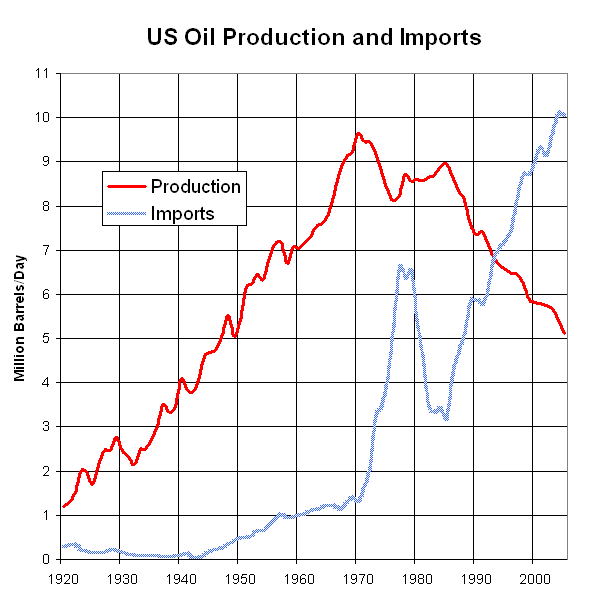
If anyone can look at the lines on this graph and explain with a straight face why we have not exploited these numerous sources of oil even as our reliance on imports has surged again over the past 25 years, please let me know -- I have a bridge connecting two of NYC's boroughs you might be interested in....
MYTH NO. 2: It's all those greedy speculators / oil companies!
Background for dispelling this myth can be found in point no. 1, as well as the following graph showing global oil discoveries and production.

Source: ASPO-USA, "Oil Discovery" (http://www.aspousa.org/index.php/peak-oil-reference/peak-oil-data/oil-discovery/), accessed March 10, 2011.
Recall from the rebuttal to myth no. 1 the lag time between discovery peak and production peak for the United States? Now, look at the time passed since global discovery peak on the above graph. The simple matter is that as supply and demand of any commodity -- be it wheat, gold, or as so comically shown in the moving "Trading Places," frozen concentrated orange juice -- begin to converge, the price of that commodity becomes much more open to extreme swings through speculative investment. As soon as speculation takes hold, the price begins to be driven more through emotion than anything else -- both on the upswing and on the downswing. It seems that people have already forgotten how quickly the price rose to $147 per barrel and subsequently crashed into the $30s only 2-3 years ago.
MYTH NO. 3: We should open up the Strategic Petroleum Reserve!
Merriam Webster defines "strategic" as:
2
b : required for the conduct of war and not available in adequate quantities domestically [strategic materials];
c : of great importance within an integrated whole or to a planned effect [strategic points];
3 : designed or trained to strike an enemy at the sources of its military, economic, or political power [strategic bomber]
Does a simple rise in the price of a commodity, no matter how precious that commodity is to conducting what we see as a "normal" life, meet any of the above definitions? Hardly.
MYTH NO. 4: There are plenty of oil reserves out there, we just have to start pumping them.
The keys to understanding oil supplies lies not in looking at simple reserve numbers, but rather looking at production and energy return on energy invested (ERoEI). For example, a field may contain reserves of 20 billion barrels. But if you can only produce 100,000 barrels each day without the possibility of damaging the well (and impacting future production), then your production is only 100,000 barrels each day.
As for ERoEI, the Canadian Tar Sands provides an excellent example. These finds may indeed contain billions of barrels of oil equivalent. They also take high amounts of energy to produce, with an estimated ERoEI of 5. This means that it costs approximately 1 barrel of oil equivalent to obtain 5 barrels of oil equivalent from the tar sands. By comparison, the West Texas fields had an ERoEI of over 50:1, in some instances approaching 100:1 (Note: I would like to provide a source for this last number, but I have read it in several places and can't readily find one with just a quick Googld search). What this means is that although there may be a lot of potential oil in the tar sands, it also takes a tremendous amount of oil to get at it. It's the equivalent of investing money toward the point that you only receive $1 for every $1 you put in -- at which point there's no longer any point in continuing. Likewise, regardless of the amount of projected reserves of tar sands, the difficult process in turning them into usable oil places a cap on the possible production well below that of light, sweet crude with an ERoEI of 50:1 and upwards.
I'll leave it at those 4 for right now. If anyone has any thoughts on this, I would appreciate hearing them. I'll probably return to this topic again in the future as more ideas come to me.
Wednesday, March 9, 2011
Sphere of influence vs. sphere of concern
I've become a big fan of podcasts over the past several months -- a trend driven largely by my 3-hour (sometimes more) daily commute to work. One of my favorite podcasts has become "The Survival Podcast" with Jack Spirko (www.thesurvivalpodcast.com), even though there is at least one thing in almost every episode that I vigorously disagree with.
In several episodes, Jack has mentioned a concept from Stephen Covey's well-known book, The Seven Habits of Highly Effective People. That concept is summarized best by the title of this post, although I believe that Covey refers to it as "circles" instead of "spheres". There are several summaries of the concept of "influence" vs. "concern" on the internet. Two of them can be found via these links:
https://www.stephencovey.com/7habits/7habits-habit1.php
http://www.ndoherty.com/circle-of-influence-circle-of-concern/
I used to live primarily in the circle of concern instead of the circle of influence. And I can speak from experience, that the more time you spend there, the more frustrated you feel at your lack of influence -- and the more your circle of influence shrinks as a result, just as Covey describes. After moving more into the circle of influence, it is amazing the feeling of empowerment I feel as compared to before -- and how I can sense my circle of influence beginning to grow and expand outward. Or at least, that's the way that it feels to me.
So, what does all of this have to do with the Survival Podcast? Basically, I think it has to do with the focus that we all need to have in the midst of challenging times in regards to what Chris Martenson (www.chrismartenson.com) has described as the "Three E's" -- Economy, Energy and Environment. What I love about Spirko's focus is that it is primarily about actions that we can all take "to live that better life if times get tough, or even if they don't."
In the spirit of living that better life, here are the things that I have been concentrating on over the past couple of months:
- Reading and researching about permaculture principles of food production
- Building some cold frames to get an early start on my garden season, as well as extend the season through the fall into the winter (I already have spinach sprouting up in one of them)
- Learning about rocket mass heaters in order to design and construct one in the summer
- Organizing a showing of Chris Martenson's "Crash Course" (www.chrismartenson.com/crashcourse) at my local library, where I was able to connect with other like-minded people in my area.
- Saving money and paying off debt through the principles embodied in Joe Dominguez and Vicki Robin's book, Your Money or Your Life.
- Making sure that I spend time playing with my daughter every day if possible, even if it's after a long work day, because it always brings a smile to my face no matter how tired I might be.
- Trying (and this is still a difficult thing) to focus on the things that I can get done in the time I have, instead of lamenting how I don't have anywhere near enough time to get the things done I want to do.
- Reminding myself every day of the reasons why I love my wife -- especially when her discomfort and raging hormones of being in her seventh month of pregnancy take over.
While writing this list, I am also forced to reflect upon the first session of my showing of Chris Martenson's Crash Course. Immediately before the event we had a short period of discussion among the attendees, and a discussion following the video that lasted for a good ninety minutes. One of the attendees there was what I would characterize as the archetypal liberal -- a type that I know well because I used to be that kind of person. Like most liberals (my old self included), she was driven primarily by her sphere of concern. As an example, she stated quite unequivocally that we needed to concentrate on the issue of population above all others, that if we would only address that issue that the others would be much easier.
Now, I'm not going to disagree with the notion that stresses on our ecosystems and natural resources have a lot to do with human overpopulation. The simple fact is that during the past 30 years we have increased from a world population of 4.5 billion to 6.5 billion, and continue to increase at a rate of over 70 million each year. The reality, however, is that aside from my own personal actions, there is little I can do about overpopulation -- and if I concentrate on that issue as this person suggested, I will end up likely alienating more people through coming off as preachy and controlling (as this person's point of view struck me) than persuading them to my point of view.
By concentrating on my circle of influence, however, and focusing my efforts on household food production, reduced home energy usage and reducing overall consumption -- I am able to serve as an example to others, perhaps bringing them to the conclusion that such actions can help lead to a better life. This, in turn, can compel them to voluntarily undertake those changes on their own, thus helping to reduce pressure on the systems that we all depend upon for some semblance of a modern life, while still maintaining the more important aspects of that modern life.
Also, in the spirit of living that better life by concentrating on my sphere of influence over my sphere of concern, I will be resuming (or would that be starting) more blog entries over the coming weeks and months. I am not doing this for the sole purpose of gaining a wide audience (although I admit that would be nice) but because the process of writing all of these things down is important to my maintaining focus on the sphere of influence and letting go of those things that exist solely within my sphere of concern. If anyone out there is reading this, I would also very much appreciate any feedback you could provide on your own thoughts on this journey.
In several episodes, Jack has mentioned a concept from Stephen Covey's well-known book, The Seven Habits of Highly Effective People. That concept is summarized best by the title of this post, although I believe that Covey refers to it as "circles" instead of "spheres". There are several summaries of the concept of "influence" vs. "concern" on the internet. Two of them can be found via these links:
https://www.stephencovey.com/7habits/7habits-habit1.php
http://www.ndoherty.com/circle-of-influence-circle-of-concern/
I used to live primarily in the circle of concern instead of the circle of influence. And I can speak from experience, that the more time you spend there, the more frustrated you feel at your lack of influence -- and the more your circle of influence shrinks as a result, just as Covey describes. After moving more into the circle of influence, it is amazing the feeling of empowerment I feel as compared to before -- and how I can sense my circle of influence beginning to grow and expand outward. Or at least, that's the way that it feels to me.
So, what does all of this have to do with the Survival Podcast? Basically, I think it has to do with the focus that we all need to have in the midst of challenging times in regards to what Chris Martenson (www.chrismartenson.com) has described as the "Three E's" -- Economy, Energy and Environment. What I love about Spirko's focus is that it is primarily about actions that we can all take "to live that better life if times get tough, or even if they don't."
In the spirit of living that better life, here are the things that I have been concentrating on over the past couple of months:
- Reading and researching about permaculture principles of food production
- Building some cold frames to get an early start on my garden season, as well as extend the season through the fall into the winter (I already have spinach sprouting up in one of them)
- Learning about rocket mass heaters in order to design and construct one in the summer
- Organizing a showing of Chris Martenson's "Crash Course" (www.chrismartenson.com/crashcourse) at my local library, where I was able to connect with other like-minded people in my area.
- Saving money and paying off debt through the principles embodied in Joe Dominguez and Vicki Robin's book, Your Money or Your Life.
- Making sure that I spend time playing with my daughter every day if possible, even if it's after a long work day, because it always brings a smile to my face no matter how tired I might be.
- Trying (and this is still a difficult thing) to focus on the things that I can get done in the time I have, instead of lamenting how I don't have anywhere near enough time to get the things done I want to do.
- Reminding myself every day of the reasons why I love my wife -- especially when her discomfort and raging hormones of being in her seventh month of pregnancy take over.
While writing this list, I am also forced to reflect upon the first session of my showing of Chris Martenson's Crash Course. Immediately before the event we had a short period of discussion among the attendees, and a discussion following the video that lasted for a good ninety minutes. One of the attendees there was what I would characterize as the archetypal liberal -- a type that I know well because I used to be that kind of person. Like most liberals (my old self included), she was driven primarily by her sphere of concern. As an example, she stated quite unequivocally that we needed to concentrate on the issue of population above all others, that if we would only address that issue that the others would be much easier.
Now, I'm not going to disagree with the notion that stresses on our ecosystems and natural resources have a lot to do with human overpopulation. The simple fact is that during the past 30 years we have increased from a world population of 4.5 billion to 6.5 billion, and continue to increase at a rate of over 70 million each year. The reality, however, is that aside from my own personal actions, there is little I can do about overpopulation -- and if I concentrate on that issue as this person suggested, I will end up likely alienating more people through coming off as preachy and controlling (as this person's point of view struck me) than persuading them to my point of view.
By concentrating on my circle of influence, however, and focusing my efforts on household food production, reduced home energy usage and reducing overall consumption -- I am able to serve as an example to others, perhaps bringing them to the conclusion that such actions can help lead to a better life. This, in turn, can compel them to voluntarily undertake those changes on their own, thus helping to reduce pressure on the systems that we all depend upon for some semblance of a modern life, while still maintaining the more important aspects of that modern life.
Also, in the spirit of living that better life by concentrating on my sphere of influence over my sphere of concern, I will be resuming (or would that be starting) more blog entries over the coming weeks and months. I am not doing this for the sole purpose of gaining a wide audience (although I admit that would be nice) but because the process of writing all of these things down is important to my maintaining focus on the sphere of influence and letting go of those things that exist solely within my sphere of concern. If anyone out there is reading this, I would also very much appreciate any feedback you could provide on your own thoughts on this journey.
Tuesday, August 24, 2010
"Kilowatt Ours" and the energy chimera
Last night I tuned into the program "Kilowatt Ours" on the New Jersey PBS station, NJN. The synopsis sounded interesting -- a look at our energy usage and how it interacts with our health and environment. Now, I did turn it on about 17 minutes in, so I'm not sure how it started out, but the first part I caught was discussing the link between burning coal, skyrocketing child asthma rates, and higher levels of mercury in expectant mothers leading to decreased cognitive ability in children. All good stuff and well documented.
Then, however, the program lost me. The documentary producer proposed his two-step program for solving these problems: 1) Energy efficiency, and, 2) Clean energy. Perhaps the most important part of the equation -- doing with LESS -- was not even broached. Then again, this was not all that surprising, since the main thrust of environmentalism and "sustainability" now seems to be continuing the same energy-rich lifestyle of the affluent by exploitative mining of the environment in means other than fossil fuels. Paul Kingsnorth, co-founder of the Dark Mountain Project, discussed this trend in environmentalism -- a moving away from concern with preserving wild spaces in a wild and unspoiled form toward this alternative mining of the environment under the mantra of "sustainability". You can read his piece here.
Quite simply put, I remain unconvinced that there is any magic bullet out there that will enable us to continue our current lavish and energy-rich lifestyles in the face of declining resource bases. Rather, we need to first prioritize our "needs" and "wants/luxuries," and then look more inwardly and locally for securing the means to the former while realizing that we need to let go of the latter. Also, I don't think that doing so requires us to abandon any hope for a good life, it just means that we need to re-define the metrics by which we define it.
Then, however, the program lost me. The documentary producer proposed his two-step program for solving these problems: 1) Energy efficiency, and, 2) Clean energy. Perhaps the most important part of the equation -- doing with LESS -- was not even broached. Then again, this was not all that surprising, since the main thrust of environmentalism and "sustainability" now seems to be continuing the same energy-rich lifestyle of the affluent by exploitative mining of the environment in means other than fossil fuels. Paul Kingsnorth, co-founder of the Dark Mountain Project, discussed this trend in environmentalism -- a moving away from concern with preserving wild spaces in a wild and unspoiled form toward this alternative mining of the environment under the mantra of "sustainability". You can read his piece here.
Quite simply put, I remain unconvinced that there is any magic bullet out there that will enable us to continue our current lavish and energy-rich lifestyles in the face of declining resource bases. Rather, we need to first prioritize our "needs" and "wants/luxuries," and then look more inwardly and locally for securing the means to the former while realizing that we need to let go of the latter. Also, I don't think that doing so requires us to abandon any hope for a good life, it just means that we need to re-define the metrics by which we define it.
Saturday, April 24, 2010
The Cognitive Dissonance of Goldman Sachs
Interesting article on the AP Newswire today: Emails show Goldman boasting as meltdown unfolds. I think it represents a case of cognitive dissonance so extreme that to try and justify it rationally only looks absurd -- a viewpoint, I believe, demonstrated by the last two paragraphs of the article (emphasis added):
However, even the earlier assertions by their top executives that government funds were never needed to maintain solvency of the firm pale in comparison to their denial of betting "against our clients." Now, they have crossed the line between unbridled arrogance and a living satire. Note, I am not making a value judgment on shorting the market while simultaneously recommending their clients to go long -- when the sole pursuit of business is the realization of profit, Goldman was behaving as we should expect a successful firm to behave. The absurdity is the lengths to which they go to try and deny that they make such a savvy business decision in order to try and maintain at least a facade of legitimacy in the eyes of the public, the veneer of which has long since been stripped.
Perhaps the reason that such things are never stated outright even goes deeper, to the heart of our current system of state-sponsored corporatism or corporate statism, depending upon your point of view. Perhaps acknowledging the savvy business sense of Goldman's action coupled with the naked immorality of that decision would make too many people question just what kind of values lay at the heart of our FIRE (Finance, Insurance, Real Estate) economy. Then, they might actually ask if those values aligned with the kind of values we want reflected in our families, communities, and society....
If you're a top Goldman exec or other member of the financial services elite, you can't have the "rabble" asking such questions. Otherwise, they might just wise up and ask what they need an industry based upon predatory, bloodsucking behavior for -- especially when they increasingly seem as if their success is built on the back of making life more difficult for a growing proportion of the populace.
Goldman said in its 2009 annual report that its short positions sought to offset its long positions in the mortgage market and did not generate large profits. Through 2006, Goldman "generally was long in exposure" in the mortgage-backed securities market, according to the report, and after taking losses on those securities in 2006 it reduced its exposure.
"Although Goldman Sachs held various positions in residential mortgage-related products in 2007, our short positions were not 'a bet against our clients,'" according to the report.Of course they were a "bet against [your] clients," Goldman Sachs. You were making bets in which you won if the housing market crashed, and simultaneously peddling products to your clients in which you assured them that what you were selling were highly rated securities when they were, actually, steaming piles of dog shit. Now, I'm not saying that Goldman didn't get hit hard by the crash of the housing market -- otherwise they never would have needed to change their status from investment bank to bank holding company in order to gain access to the Fed borrowing window.
However, even the earlier assertions by their top executives that government funds were never needed to maintain solvency of the firm pale in comparison to their denial of betting "against our clients." Now, they have crossed the line between unbridled arrogance and a living satire. Note, I am not making a value judgment on shorting the market while simultaneously recommending their clients to go long -- when the sole pursuit of business is the realization of profit, Goldman was behaving as we should expect a successful firm to behave. The absurdity is the lengths to which they go to try and deny that they make such a savvy business decision in order to try and maintain at least a facade of legitimacy in the eyes of the public, the veneer of which has long since been stripped.
Perhaps the reason that such things are never stated outright even goes deeper, to the heart of our current system of state-sponsored corporatism or corporate statism, depending upon your point of view. Perhaps acknowledging the savvy business sense of Goldman's action coupled with the naked immorality of that decision would make too many people question just what kind of values lay at the heart of our FIRE (Finance, Insurance, Real Estate) economy. Then, they might actually ask if those values aligned with the kind of values we want reflected in our families, communities, and society....
If you're a top Goldman exec or other member of the financial services elite, you can't have the "rabble" asking such questions. Otherwise, they might just wise up and ask what they need an industry based upon predatory, bloodsucking behavior for -- especially when they increasingly seem as if their success is built on the back of making life more difficult for a growing proportion of the populace.
Thursday, April 22, 2010
Dick Cheney endorses Marco Rubio immediately following allegations of corruption
From the "you can't make this shit up" file, here's an interesting paragraph out of an AP article today:
Former Vice President Dick Cheney was the latest to give his support Thursday, a day after [Marco] Rubio repaid Florida's Republican Party $2,417 for double-billed flights, an expense he blamed on an accounting error he discovered after the first of several stories on the flap appeared a few weeks ago in The Miami Herald and the St. Petersburg Times.So, let me get this straight -- the former VP, CEP of Haliburton and Defense Secretary Dick Cheney, the same Dick Cheney that was at the heart of so many nexuses (is it nexuses or nexi?) of corruption between the public and private sectors, endorses Marco Rubio AFTER he is implicated in several ethics scandals? It does seem that the universe has a sense of humor, after all....
Another example of the disintegration of the center, from FPR
It's almost as if things have come full-circle. Where I once traveled in decidedly left-wing political circles, I have come to greatly appreciate -- nay, rely upon -- the work of the more conservative intellectuals at Front Porch Republic. I don't frequent them in order to find an echo chamber, unlike the more prevalent tendencies in the American populace. I go there because it: 1) Intellectually challenges my own convictions and perspective, which is more on the left than the right, and 2) Demonstrates frequently and repeatedly areas for broad cooperation between people on the left and right who still believe in antiquated notions of discussing ideas civilly and rationally -- but still passionately. In that way, they are a refreshing antidote to the mind-numbing monotony of beltway gossip and public relations generated talking points repeated ad nauseum that is offered by our mainstream outlets. D. W. Sabin's piece, "The Duma on the Potomac, for the Greater Glory of Government," provides a good example of this.
Truth be told, I was hooked on Sabin's piece from the start:
What does all of this have to do with Sabin's article? I think that by questioning the very notion that we are in a Golden Age right now, and instead looking at the current American manifestation of Western Civilization as something far less from grand in a spiritual (in the broadest form) sense, Sabin is demonstrating what happens when the center is seen as no longer holding. What we get are not battles of rhetoric and ideas, but clashes of hardened ideology (as in the neo-cons vs. the tea party crowd over the soul of the Republican Party, or the "conservatives" vs. "liberals" over what brand of evil we are going to more readily embrace, old or new).
It also informs our reading of Tainter's work, especially as to what else we should expect if the disintegration of the center is a presage of a broader "collapse" of the way of life we are all accustomed to experiencing. The real question then becomes, what kind of institutions will be formed out of the scrap heap of the old ones? Will they be a potemkin prosperity for an increasing few, a broad and deep raznochintsy ("people of no worth"), and power structures that rely upon direct coercion to maintain such high levels of inequality? Or will we instead answer to the "better angels of our nature" and create something of lasting beauty out of the wreckage? I know which way my rational sense tells me, but nevertheless I have to remain hopeful because, if hope is lost, then what is the point?
Truth be told, I was hooked on Sabin's piece from the start:
Ambrose Bierce, in his magnificently arch “Devils Dictionary” defined a Conservative thusly: Conservative, n. A statesman who is enamored of existing evils , as distinguished from the liberal, who wishes to replace them with others”.Anything that starts off with an acerbic quote that immediately sets such a deliciously cynical "pox on both your houses" tone... well, I guess you could say that my curiosity is always piqued. But all joking aside, Sabin hit something later that really made me think and reflect:
Meanwhile, the frustrations of being forced to watch a slow-motion train wreck are resulting in a splintering of the slap-happy Grand Old Party into renegade bands of Mensheviks and Bolsheviks. The American Mensheviks have their Trotsky in the Big Government Neo-Conservatives who wish for progress but only that kind of progress which will maintain the existing forms of government modified, of course, in their world-transforming image. The American Bolshys , on the other hand, are the mad-as-hell Tea Party with their sexpot Lenin Sarah Palin, fresh from cash-cow book tour and on a First Class Junket into Everyday Celebrity. These two “revolutionary” combatants against the evil Liberal gentry will now duke it out with a wrestling card of opinion that is sure to be exciting, while their opponents in the Intelligentsia will continue to concoct a thinly veiled bunko in the general schemes of space travel, democracy at gunpoint and fiat money economic legerdemain. The Show Must Go On.
One thing is certain, like in Russia during the last gasp of the Tsars, Terror will be ever-present, although its perpetrators shall be few and at the end of the day, the raznochintsy will still be “the people of no worth.”
The other day, I overheard President Obama as he held forth on the potentials of our storied Space Program. He announced that he intended to hand the low earth orbit taxi service concession over to our Cosmonaut friends in Russia while applying our own efforts to heavy cargo lifting for exploration deeper into space, concurrent with the development of commercial earth orbit space transportation. In his remarks, he declared without a hint of irony that he wanted America to not only embrace the future but to actually “leap into the future”. Stirring words perhaps, redolent of the Kennedy through Nixon effort to land an American on the Moon but amidst the current economic crisis , the idea that we might like to “leap into the future ” seems downright escapist if not wholly comic. I can hear the Exceptionalists and Positivists grumbling now that I am resorting to a retreat from our technological abilities and embracing American Decline. I am doing nothing of the sort, I’m simply acknowledging the very clear signals that we have not yet reached such an exalted state that would merit the idea of decline from it. The flesh is willing but the spirit is dead and buried.I recently completed reading Joseph Tainter's The Collapse of Complex Societies, a very densely and scholarly written, yet wonderful book that specifically targets the pattern of collapse in ancient civilizations as different as the Western Roman Empire, the Maya and the Chacoans of the American Southwest. Now, I'm grossly generalizing here, but basically Tainter's conclusion (based on archeological study compared to current demographic trends) is that all complex societies are eventually done in by the patterns that fueled their rapid growth, because those patterns offer diminishing -- and eventually negative -- marginal returns on all investments of energy. The simplest example is in terms of military conquest -- initial conquests are close to home and offer a flood of new resources, making the conquest able to pay for itself and then some. However, continued expansion eventually hits up against the wall of becoming prohibitively expensive and difficult to carry out, and even the maintenance of conquered lands provides a growing drain on the investment against declining yields. Finally, the centralization of power that develops out of the need to effectively administer larger amounts of territory begins to lose legitimacy as it proves increasingly incapable of addressing the diminishing returns of expansion and complexity. In short, the center no longer holds.
What does all of this have to do with Sabin's article? I think that by questioning the very notion that we are in a Golden Age right now, and instead looking at the current American manifestation of Western Civilization as something far less from grand in a spiritual (in the broadest form) sense, Sabin is demonstrating what happens when the center is seen as no longer holding. What we get are not battles of rhetoric and ideas, but clashes of hardened ideology (as in the neo-cons vs. the tea party crowd over the soul of the Republican Party, or the "conservatives" vs. "liberals" over what brand of evil we are going to more readily embrace, old or new).
It also informs our reading of Tainter's work, especially as to what else we should expect if the disintegration of the center is a presage of a broader "collapse" of the way of life we are all accustomed to experiencing. The real question then becomes, what kind of institutions will be formed out of the scrap heap of the old ones? Will they be a potemkin prosperity for an increasing few, a broad and deep raznochintsy ("people of no worth"), and power structures that rely upon direct coercion to maintain such high levels of inequality? Or will we instead answer to the "better angels of our nature" and create something of lasting beauty out of the wreckage? I know which way my rational sense tells me, but nevertheless I have to remain hopeful because, if hope is lost, then what is the point?
Saturday, April 17, 2010
Human Extensions of Our Machines
A couple of weeks ago, I was watching an interview with one of my favorite bloggers, John Michael Greer (The Archdruid Report) on Peak Moment television. And, like most of the time I'm exposed to Greer's thinking, there was something that really made me stop and think. I've copied that section from the transcript below. You can find the entire interview -- video, audio and transcript -- at http://www.energybulletin.net/media/twilight-age#transcript
While humans have used machines to complete tasks throughout all of our history on this earth, starting with the use of rocks by the earliest hominids, at all times those machines were an extension of our human selves. Cheap energy and industrialism, however, sought to reverse this relationship. According to Taylor and the factory operators who followed his advice, human workers were to become extensions of the machines they operated.
This attitude, Greer points out, has now spilled into our personal relationships as well. One reason behind a divorce rate that hovers around 50% could be the changes in the way we relate to each other. I came across an article in Psychology Today a few weeks back that addressed this high divorce rate and, more importantly, how to avoid being one of those failed relationships contributing to it. The main point of the authors was that many of us get married expecting our spouse to be everything that we are looking for, and often without much time or effort put in on our part. When our spouses fail to live up to our lofty expectations, we convince ourselves that the cause of our unhappiness lay in them, and that the "perfect person" is still waiting for us out there to fulfill all of our needs. The authors of the article write that this way of thinking is rooted in our world of nearly limitless choices. I think they're right, but they still tread too near the surface. Our modern world of limitless choices is a product of cheap, abundant energy and the mass-production through machines that it powered. In a world of abundance, there no longer has to be any negotiation, any compromise -- when someone fails to meet your expectations, they can be thrust aside in favor of others who can better make us happy... until, after a certain amount of time, when we realize that the second person is also less-than-perfect, and the cycle repeats itself and leaves us consistently unfulfilled.
This "industrial conditioning" has manifested itself in our politics as well. While people have always divided over issues, ideas and worldview since the beginnings of complex civilization, our modern society has taken this to the extreme. People of differing viewpoints can choose to avoid interacting with each other now, even to the point of completely avoiding exposure to other viewpoints, where before their physical and social proximity often meant that they had to negotiate and compromise. The result is a completely polarized politics in which opposing camps claim the mantle of their own ideological purity and level charges of the unquestionably evil intentions at their opponents. In this game, there is never any "working it out" -- instead, success is portrayed as occurring only if "my side" is able to enact its agenda completely and fully, and the "other side" is completely marginalized or even purged from the political process (or, in the more extreme instances, literally purged from society).
So, what does this all mean in the grand scheme of things? In the current sense, it means that we have abandoned the kinds of negotiation and compromise that was necessary for human relationships and, by extension, survival, for a mechanistic kind of thinking in which other people exist only to meet our needs, much as our machines do. If we do face a difficult, industrialized future based upon declining supplies of fossil fuels and a more unpredictable and unstable climate and environment, such an approach will not work. Cooperation and community, as Greer pointed out, are not the result of treating people like machines. They are the result of learning to get along with others and accepting the ways in which they differ from us -- because in the end analysis it is the common ground, the end result of negotiation and compromise, that has ensured our survival as a species for all but the last 0.1% of our existence on this planet.
(John Michael Greer): One of the things about the age of cheap energy is that it’s made us think that, it’s made us ignore our own capacities, our own potentials as human beings, and encouraged us to focus instead on what we can make machines do. And on the one hand that leads to ignoring a lot of our potential as human beings, but it also leads to a very specific kind of thinking in terms of power relationships. You don’t have a conversation with your car or with your alarm clock…you tell it what to do. And what it doesn’t do exactly what you do you get grumpy, and you take it to the repairman or you throw it out and buy a new one. You don’t converse with it, you don’t live with it you don’t…Whether you agree or disagree with Greer's ideas about a post-industrial future, I think he's on to something quite significant here regarding to the way that human relationships have changed with the introduction of cheap energy. The most obvious in a historical sense, at least from my perspective, is the introduction of Taylorism (the ideas of scientific management of the workplace introduced by Frederick Taylor in the late 19th and early 20th century). In the crudest sense, Taylorism sought to remove every last trace of humanity from the factory. Assembly-line tasks were broken down into specific movements made by workers to perform each task, and a time value in seconds or even fractions of a second was assigned to each movement. If employees were tired from working on the factory floor for fourteen hours with only twenty minutes for lunch and two ten-minute bathroom breaks, it did not matter. According to the principles of Scientific Management, they should be performing their tasks within the same amount of time.
(Janaia Donaldson): You don’t work things out…
(JMG): There’s no negotiation, there’s no sharing, there’s no community…
(JD): Right, that’s true.
(JMG): And so it’s encouraged a very mechanistic attitude that we apply to ourselves, we apply to each other, we apply to the living earth that supports all of our lives. And it’s not been…I mean it’s had some very negative consequences. One of the things that we need to reacquaint ourselves with is the fact that our own capacity…I mean human beings have enormous capacities that we’ve left unused for 300 years. And we need to reacquaint ourselves with our own capacities, with our own innate human abilities to do a whole range of things. We are actually, you know, we are a very successful life form. We’ve got a lot of capacities that we’ve evolved down through millions of years and we need to put those to work rather than just running to a machine. And, on the one hand that’s all we’ve got left now, is ourselves. On the other hand, I’m not sure we actually need that much more than ourselves and each other, and of course the natural world that supports our lives.
While humans have used machines to complete tasks throughout all of our history on this earth, starting with the use of rocks by the earliest hominids, at all times those machines were an extension of our human selves. Cheap energy and industrialism, however, sought to reverse this relationship. According to Taylor and the factory operators who followed his advice, human workers were to become extensions of the machines they operated.
This attitude, Greer points out, has now spilled into our personal relationships as well. One reason behind a divorce rate that hovers around 50% could be the changes in the way we relate to each other. I came across an article in Psychology Today a few weeks back that addressed this high divorce rate and, more importantly, how to avoid being one of those failed relationships contributing to it. The main point of the authors was that many of us get married expecting our spouse to be everything that we are looking for, and often without much time or effort put in on our part. When our spouses fail to live up to our lofty expectations, we convince ourselves that the cause of our unhappiness lay in them, and that the "perfect person" is still waiting for us out there to fulfill all of our needs. The authors of the article write that this way of thinking is rooted in our world of nearly limitless choices. I think they're right, but they still tread too near the surface. Our modern world of limitless choices is a product of cheap, abundant energy and the mass-production through machines that it powered. In a world of abundance, there no longer has to be any negotiation, any compromise -- when someone fails to meet your expectations, they can be thrust aside in favor of others who can better make us happy... until, after a certain amount of time, when we realize that the second person is also less-than-perfect, and the cycle repeats itself and leaves us consistently unfulfilled.
This "industrial conditioning" has manifested itself in our politics as well. While people have always divided over issues, ideas and worldview since the beginnings of complex civilization, our modern society has taken this to the extreme. People of differing viewpoints can choose to avoid interacting with each other now, even to the point of completely avoiding exposure to other viewpoints, where before their physical and social proximity often meant that they had to negotiate and compromise. The result is a completely polarized politics in which opposing camps claim the mantle of their own ideological purity and level charges of the unquestionably evil intentions at their opponents. In this game, there is never any "working it out" -- instead, success is portrayed as occurring only if "my side" is able to enact its agenda completely and fully, and the "other side" is completely marginalized or even purged from the political process (or, in the more extreme instances, literally purged from society).
So, what does this all mean in the grand scheme of things? In the current sense, it means that we have abandoned the kinds of negotiation and compromise that was necessary for human relationships and, by extension, survival, for a mechanistic kind of thinking in which other people exist only to meet our needs, much as our machines do. If we do face a difficult, industrialized future based upon declining supplies of fossil fuels and a more unpredictable and unstable climate and environment, such an approach will not work. Cooperation and community, as Greer pointed out, are not the result of treating people like machines. They are the result of learning to get along with others and accepting the ways in which they differ from us -- because in the end analysis it is the common ground, the end result of negotiation and compromise, that has ensured our survival as a species for all but the last 0.1% of our existence on this planet.
Sunday, March 14, 2010
Beyond Capitalism and Socialism
Allan Carlson published the following article at Front Porch Republic: http://www.frontporchrepublic.com/2010/03/beyond-capitalism-and-socialism-rebuilding-an-american-economy-focused-on-family-and-community/. Essentially, it says very cogently many things that I have felt for some time -- namely, that the ideologies of capitalism and socialism are essentially two sides of the same ideological coin, part of a process that embodies Joseph Schumpeter's notion of "creative destruction," and that neither of them gives a passing thought to the value of what is being destroyed (family and community).
Carlson's essay is significant not only because it waxes philosophical about different modes of organizing ourselves to create a more humane society, but also because it provides a way forward in a world that is rapidly approaching limits of fossil fuels, climate disruption, population, and so forth. Also, it represents something that transcends old ideological divisions of right and left -- it is embraced by people from as divergent backgrounds as Carlson and Rod Dreiher (on the right) and Sharon Astyk and myself (from the left).
Perhaps this strange new political re-alignment has the capacity to help us more adequately deal with the social, economic and ecological predicaments we face over the next twenty years as compared to the increasingly ineffective "solutions" offered by the traditional right and left. We shall see....
Carlson's essay is significant not only because it waxes philosophical about different modes of organizing ourselves to create a more humane society, but also because it provides a way forward in a world that is rapidly approaching limits of fossil fuels, climate disruption, population, and so forth. Also, it represents something that transcends old ideological divisions of right and left -- it is embraced by people from as divergent backgrounds as Carlson and Rod Dreiher (on the right) and Sharon Astyk and myself (from the left).
Perhaps this strange new political re-alignment has the capacity to help us more adequately deal with the social, economic and ecological predicaments we face over the next twenty years as compared to the increasingly ineffective "solutions" offered by the traditional right and left. We shall see....
Friday, September 25, 2009
Personal perspective on problems with our privatized health care system
Many of the debates surrounding health care seem to dwell in the realm of ideology and polemics, and fail to address the way in which this issue meaningfully intersects with people's lives. I have had numerous exchanges with a good friend of mine on this issue, and we find ourselves in disagreement over it. However, this is an issue that did directly affect me over the past year, and I think it's important to discuss that in order to change the tone of debate.
About 15 months ago, I was dismissed from my position as a teacher in a public high school. I'm not going to go into details regarding that dismissal, other than to say that it was likely due to personality conflicts more than my performance as an aggregate over the entire year, from start to finish. I had invested a good portion of myself in that job, regularly putting in an additional 25-30 hours per week outside what I spent in the classroom, so when the district administration essentially let me know that my efforts were not valued nor appreciated, it affected me quite significantly. I had to eventually seek counseling in order to maintain my state of mind while working in a less-than-hospitable environment.
When the fall came and I was still unemployed, and my family was facing great financial difficulty as a result, I slipped into the depths of a depression that I just could not get out of. By depression I am not talking about just feeling a "little down," I am talking of being consumed with thoughts for significant lengths of time on how to hang myself down in my basement, or to simply speed up my car and swerve into a bridge abutment, and so forth. I'm not kidding in the least -- it got that bad. I probably was not that far from actually acting on these impulses, a thought that sends chills down my spine today when I think about how it would have affected my wife and young daughter.
When my wife finally confronted me on this and basically told me that I had to get some kind of help, I figured that the best place to turn would be the counselor I saw at the end of the previous school year since we already had an established relationship. I needed help immediately, so I scheduled an appointment and resumed counseling.
Since I had lost my job, we also lost the health insurance policy we had used the previous year and had to switch to my wife's plan. Not to worry my counselor told me, he was a participant in my new plan, so all I had to do was to make the co-pays. Except after a few sessions, I started receiving statements from my wife's insurance demonstrating that my counselor was NOT a participating provider, so the services were not covered, and instead of paying a $30 co-pay for the appointments I would have to cover $120 per visit!
As it turned out, the provider we had (and still have) has a myriad of different plans. While my counselor was a participating provider on most or all of the other plans, he was not a participating provider on the specific plan that we had. Fortunately for me, he was willing to drop the fee from $120 to $60 per visit, and I was able to keep seeing him. Eventually, after going on medication for a period of time, I was able to gain the perspective on my illness and overcome it. However, this experience certainly gave me a personal perspective on our health care system as it currently is, and how it needs fixed.
First of all, one of the common refrains heard in opposition to any kind of government-run system is that "decisions should be left between a doctor and patient, not put in the hands of some government bureaucrat." Funny thing is, under our for-profit system, decisions were NOT in the hands of my provider and myself. They were subject to corporate decisions.
Secondly, losing one's job and the inability to get another one is one of the most traumatic experiences that a person can go through -- especially a man in our society. When I was not able to work, I felt that I could not make any contributions to my family -- primarily because the way our society measures a person's worth to their family is the financial income they contribute. I was lucky in that my wife has a successful career that provides us health insurance. Given the current state of our economy, what about the millions of others who may be in similar situations but are not fortunate enough to have a "Plan B" like we had? Where do they turn in our for-profit system that ties health insurance to employment status? Answer: there is NOWHERE for them to turn.
Thirdly, when I lost my job an additional $30 (or $60) per week in counseling expenses was one that we really could not afford on our already-strained budget. When you don't have income, a medical co-pay can be something that strains your home finances past the breaking point. However, given my state of mind at the time, forgoing professional help was not really an option. Lucky for us, my parents stepped in and paid for the services. But regardless of our good fortune in this regard, what are those who are not lucky enough to have outside support like us supposed to do? Where are they to turn under our current for-profit system? Answer: there is NOWHERE for them to turn. It is undoubtedly situations like mine (and more dire than mine) that are the reason that medical costs are the #1 reason for bankruptcy filings in our nation over the past several years.
Now, the self-interested way of looking at this scenario might be for me to simply say that I was able to get through it and make it work, therefore other people should do the same. However, I cannot do that when I think of others who could be going through similar (or worse) circumstances and do not have the outside support to get the help they need. This is why I support, at a minimum, a public option in our health care system. I would rather see a single-payer system, because I believe it would completely circumvent many of the problems that I encountered. However, a public option would ensure that those who find themselves unemployed, underemployed, or in other difficult circumstances would not be simply left out in the cold.
At the heart of the matter, our health care is a MORAL ISSUE. It speaks to who we are as a society. It is way past due to listen to the better angels of our nature, and show ourselves to be a society that promotes the common welfare rather than self-interest. It is past time to institute a viable public option that will allow the government to use its volume to negotiate for lower prescription drug and service costs. It is past time to ensure that people have access to services WHEN THEY NEED THEM, and not tie that access to present employment status in an economic downturn.
I support a government takeover of our healthcare system because, based on my own experience and the mountains of evidence available, our current for-profit system has failed too many of those who needed health care. It is well past time for them to step aside. The kind of thinking and approach that got us into our current predicament is not going to get us out of it.
About 15 months ago, I was dismissed from my position as a teacher in a public high school. I'm not going to go into details regarding that dismissal, other than to say that it was likely due to personality conflicts more than my performance as an aggregate over the entire year, from start to finish. I had invested a good portion of myself in that job, regularly putting in an additional 25-30 hours per week outside what I spent in the classroom, so when the district administration essentially let me know that my efforts were not valued nor appreciated, it affected me quite significantly. I had to eventually seek counseling in order to maintain my state of mind while working in a less-than-hospitable environment.
When the fall came and I was still unemployed, and my family was facing great financial difficulty as a result, I slipped into the depths of a depression that I just could not get out of. By depression I am not talking about just feeling a "little down," I am talking of being consumed with thoughts for significant lengths of time on how to hang myself down in my basement, or to simply speed up my car and swerve into a bridge abutment, and so forth. I'm not kidding in the least -- it got that bad. I probably was not that far from actually acting on these impulses, a thought that sends chills down my spine today when I think about how it would have affected my wife and young daughter.
When my wife finally confronted me on this and basically told me that I had to get some kind of help, I figured that the best place to turn would be the counselor I saw at the end of the previous school year since we already had an established relationship. I needed help immediately, so I scheduled an appointment and resumed counseling.
Since I had lost my job, we also lost the health insurance policy we had used the previous year and had to switch to my wife's plan. Not to worry my counselor told me, he was a participant in my new plan, so all I had to do was to make the co-pays. Except after a few sessions, I started receiving statements from my wife's insurance demonstrating that my counselor was NOT a participating provider, so the services were not covered, and instead of paying a $30 co-pay for the appointments I would have to cover $120 per visit!
As it turned out, the provider we had (and still have) has a myriad of different plans. While my counselor was a participating provider on most or all of the other plans, he was not a participating provider on the specific plan that we had. Fortunately for me, he was willing to drop the fee from $120 to $60 per visit, and I was able to keep seeing him. Eventually, after going on medication for a period of time, I was able to gain the perspective on my illness and overcome it. However, this experience certainly gave me a personal perspective on our health care system as it currently is, and how it needs fixed.
First of all, one of the common refrains heard in opposition to any kind of government-run system is that "decisions should be left between a doctor and patient, not put in the hands of some government bureaucrat." Funny thing is, under our for-profit system, decisions were NOT in the hands of my provider and myself. They were subject to corporate decisions.
Secondly, losing one's job and the inability to get another one is one of the most traumatic experiences that a person can go through -- especially a man in our society. When I was not able to work, I felt that I could not make any contributions to my family -- primarily because the way our society measures a person's worth to their family is the financial income they contribute. I was lucky in that my wife has a successful career that provides us health insurance. Given the current state of our economy, what about the millions of others who may be in similar situations but are not fortunate enough to have a "Plan B" like we had? Where do they turn in our for-profit system that ties health insurance to employment status? Answer: there is NOWHERE for them to turn.
Thirdly, when I lost my job an additional $30 (or $60) per week in counseling expenses was one that we really could not afford on our already-strained budget. When you don't have income, a medical co-pay can be something that strains your home finances past the breaking point. However, given my state of mind at the time, forgoing professional help was not really an option. Lucky for us, my parents stepped in and paid for the services. But regardless of our good fortune in this regard, what are those who are not lucky enough to have outside support like us supposed to do? Where are they to turn under our current for-profit system? Answer: there is NOWHERE for them to turn. It is undoubtedly situations like mine (and more dire than mine) that are the reason that medical costs are the #1 reason for bankruptcy filings in our nation over the past several years.
Now, the self-interested way of looking at this scenario might be for me to simply say that I was able to get through it and make it work, therefore other people should do the same. However, I cannot do that when I think of others who could be going through similar (or worse) circumstances and do not have the outside support to get the help they need. This is why I support, at a minimum, a public option in our health care system. I would rather see a single-payer system, because I believe it would completely circumvent many of the problems that I encountered. However, a public option would ensure that those who find themselves unemployed, underemployed, or in other difficult circumstances would not be simply left out in the cold.
At the heart of the matter, our health care is a MORAL ISSUE. It speaks to who we are as a society. It is way past due to listen to the better angels of our nature, and show ourselves to be a society that promotes the common welfare rather than self-interest. It is past time to institute a viable public option that will allow the government to use its volume to negotiate for lower prescription drug and service costs. It is past time to ensure that people have access to services WHEN THEY NEED THEM, and not tie that access to present employment status in an economic downturn.
I support a government takeover of our healthcare system because, based on my own experience and the mountains of evidence available, our current for-profit system has failed too many of those who needed health care. It is well past time for them to step aside. The kind of thinking and approach that got us into our current predicament is not going to get us out of it.
Subscribe to:
Posts (Atom)