Saturday, July 30, 2011

Tomato Sauce -- First Batch of 2011


I finally had enough Amish Paste and Juliet tomatoes to make this season's first batch of sauce today.  This is the first year that I'm using an Italian tomato press for making sauce, and I have to say that it makes the task much, much easier than skinning tomatoes and de-seeding them by hand!

The press that I got is a Roma food strainer & sauce maker that I purchased from Weston Supply for around $65 including tax and shipping.  The order also included a bonus 4-piece accessory kit of different strainers that allow me to process just about any kind of soft fruit, vegetable or berry with it.  If today was an indication of how much value I'm going to get out of this thing, then I have to say that it will be worth every penny several times over.  The only complaint I have with it so far is that the strainer wanted to rotate around the suction-cup base as I was turning the crank, but that could also be due to putting a light coating of oil on the rubber to help it stick better.  Next time I'll just do it dry and see if it eliminates the problem.

Here's a picture of the tomato press with the hopper full of quartered tomatoes.  You press the tomatoes down into the hopper with the red plunger sitting on top, then by turning the crank a screw inside of the press forces them through the first strainer.  The threads on the screw get smaller the further out they go, and the diameter of the strainer gets smaller at the same time, so it pushes out all of the juice and even a good bit of pulp, which flows down the chute into the bowl on the right.  The skins, seeds and remainder of the pulp get spit out the end and into the second bowl.  You definitely lose some pulp this way, but for the amount of work it saves it's well worth it.

Roma brand Food Strainer and Sauce Maker, filled and ready to process


And here's me and my #1 helper for all things gardening -- my four year old daughter.  It's amazing to me how much she wants to help me with everything I do.  All I have to do is disappear into the garden and she'll find me within 5 minutes, wanting to be let in the gate, wanting to help me pick whatever is ready.  In case you're wondering about the outfit, she's getting ready to head out to her gymnastics class right as I was processing the tomatoes -- but she wouldn't be satisfied if she couldn't turn the crank on the press!  I guess this all shows another benefit of gardening -- it provides a productive activity that parents and children can do together.

Daddy and daughter time -- there's nothing like it!

Finally, here's the final product ready to be cooked down in a stock pot.  I put in some fresh oregano and basil leaves, along with a little bit of olive oil, and it will take most of the day to cook down into sauce.  I'll probably lose close to half of the volume, but that will only concentrate the flavor.  After that, I'll can it in mason jars using a hot water bath, label it with some masking tape and a Sharpie marker, and put it up on the shelf to save for the winter.  During the summer we don't use much sauce,  preferring instead to just stew mixed vegetables in a white wine and garlic base for over our pasta.

Ready to cook down

I failed to mention one of the best benefits of living with a garden, besides the cheap and delicious vegetables that are better than anything you can get in the supermarket anymore -- the fact that kids actually like them.  Our daughter turned to us the other night when she had half-finished her dinner of a grilled hot dog and roasted mixed vegetables and said, "Mommy and daddy, I don't want any more of my hot dog.  Is it OK if I just eat the rest of my vegetables?"  My wife and I just looked at each other, wide-eyed, and replied with half-stunned voices, "Sure, go ahead."

Even if you don't have a garden for fresh tomatoes and herbs, you can always pick them up from local farms and farmers' markets.  Look for "seconds" that might be slightly bruised or almost past the point of ripeness to get a better deal.  If you have a tomato press, there's no reason you can't make sauce like this.  Homemade tomato sauce also makes a great gift for friends over the winter -- I can guarantee that most people will appreciate it much more than another bottle of store-bought wine!

As always, your comments are welcome and, if you like this sort of thing, please take a moment and pass it along to your friends.  Thanks!

Thursday, July 28, 2011

Permaculture as a key to my Better Life


Five years ago, I started out as a beginning gardener, armed with a copy of Mel Bartholemew's Square Foot Gardening and my mother's accumulated wisdom from a lifetime of practicing the craft.  But gardening really is a gateway drug -- it's bound to lead to stronger stuff, if you delve past its surface.  The past year or so has opened me up to the great world of permaculture, a different system of producing food and, ultimately, organizing your life.  It is about learning to produce more while consuming less, freeing up ample time to share with your family, friends and community.  If you're not really familiar with permaculture, read on and I'll share an overview, as well as why and how I integrate it into my life.


An Ethical System

One of the things that drew me to permaculture is that, although engaging scientific methods of hypothesis, trial and observation, it is at its heart guided first by an ethical code.  This allows its practitioners to approach the world from a more holistic and less reductionist starting point.  Masanobu Fukuoka, author of The One Straw Revolution (a short, wonderful book on what Fukuoka called "natural farming") took this argument even further -- he said that it was really pointless to try and figure out why or really how nature did what it did -- you saved a lot of time if you just focused on what it did.  More on that point a little later....

Permaculture's core ethic is, like most things having to do with it, simple in words but extremely complicated in practice.  According to Bill Mollison, author of Permaculture: A Designer's Manual the "prime directive" of permaculture is to live a life in which we take responsibility for our lives, and those of our children.  There are three additional guiding principles of how to pursue this end:
1. Care for the earth
2. Care for people
3. Minimize consumption of resources

Now, I'm aware that some people may look at that last point and take offense, saying it is in their right to consume what they want.  That's anyone's prerogative to look at things that way.  However, permaculture actually opens a path to more -- more food, more health, more time to spend with the people you care about.  I'll expand on this last point in the final section of this piece.


Mimicking Nature

Permaculture takes its cues from nature.  Permaculturalists don't want to control nature, they want to take advantage of the things that it already does much better than we can.  The key to this approach is to observe nature and take note of its patterns.  For instance, think of an open field coming to a forest's edge.  Where is nature the most varied and active in that setting -- in the field, in the forest, or where the two meet and overlap?  It's the transition zone that has the most action, the area that permaculture calls "edge".  One of the goals in practice is to try and maximize edge throughout your system.

Biological diversity is at its peak in these edges -- therefore that's a condition that we want to embrace and encourage in permaculture as well.  We want plants and other life forms, such as fungi, worms and insects to be able to take advantage of some of the natural ways that they help each other.  Allow nature to do the work for you.

Observation provides the key to knowing what combinations work and which ones don't.  Some of these are counter-intuitive.  To revisit Fukuoka, he found that even a blight that commonly took out 20% of his rice crop every year, because it cleared the way for the healthy plants to produce even more while also encouraging stronger seeds for next year's crop -- resulting in harvests that equaled or surpassed those of his chemical-and-petroleum farming neighbors.  This brings me to the last, but most important feature of permaculture -- the benefits.


Getting More from Less

Permaculture is about production.  For me, it is a tool to use to make my bridge to freedom, because it does more from less -- allowing me to cut loose from reliance on too many outside systems.  The term that Mollison and most others use for this is yield.

Yield in permaculture is a greater matter than just how much money you spend in a year compared to how much you make.  In line with the third principle (see above), it takes into account resources used.  For most of modern farming, this means that petroleum and chemicals have to be considered for their entire production chain.  This demonstrates how inefficient our current systems really are.  Permaculture, instead of looking for outside inputs, tries to "close the loop" in as many ways as possible.  By closing the loop, I mean recycling materials through natural processes so that "wastes", instead of being discarded, instead become useful "inputs" that boost our yields. 

We can try to mimic these systems in order to encourage faster development.  A healthy soil is key to a good permaculture operation, so we need to do things that encourage healthy soil development and maintenance.  Nature has already provided a model -- the forest floor where leaves, limbs and animal carcasses fall to be gradually broken down by the fungi, mold and other organisms into beautiful black humus.  A common way of mimicking this process among most serious gardeners is composting.  By recycling food waste we are keeping it out of landfills, relying less on oil-fueled trucks to transport them or oil-fueled equipment to build the facility -- and for giving up our "right" to consume all of these resources, we end up with a substance that we can add to our garden soil to increase production.  Less in --> more out.

We also want to conserve water.  This has been referred to as "making water walk instead of run".  If you can slow water down to a speed where it is absorbed into the soil instead of runoff, it means less watering -- and less work.  There are some simple ways to do this.  One is to dig berms and swales along the contour lines of an area, giving the water nowhere to flow but a large space to sit.  As the water sits, it is absorbed into the berm and permeates through it, giving plant roots an opportunity to drink it up.  This method has even "greened the desert" next to the Dead Sea -- a place that otherwise looks like a moonscape of rock under a blazing hot sun.  Another method is to just dig lots of holes to catch the water, and planting around the hole's edge.  (There's that edge again!)  My garden is on a slight slope, and what I did was to build unbordered raised beds crossing the slope, allowing the beds to serve as berms and the mulched footpaths between as swales.  In any event, I just came out of a couple of weeks of dry, hot (approaching 100) weather in NY while hardly needing to water my plants.  I have 15 tomato plants that remained green and vigorous throughout.

Earlier we talked a bit about biodiversity.  The most basic method of achieving this is companion planting -- interspersing different vegetables in your garden together.  It's what I do, and again the result has been a vigorous and healthy garden with little to no watering under sustained hot, dry conditions.  Some permaculturists may take issue with my inclusion of companion planting, but I just see it as a simpler system of guilds.  Guilds are where you randomly mix groups of plants together (literally tossing mixed seed onto the ground in some instances), preferably at least some perennials, in order to take advantage of symbiotic relationships between the plants.  I'm not there yet, but companion planting is a simpler step along that path.


I certainly don't claim to be an expert on permaculture, and I readily admit that I'm a novice. But that's the great thing about permaculture, it's a long, patient process so it's more important to just jump in and see what happens.  I still kill a lot of plants (the difference between an experienced and unexperienced gardener is just the greater number of plants that the former has killed compared to the latter).  But I have seen my overall yields rise while reducing the time that I have to spend weeding and watering.  A large part of the permaculture approach is embracing inaction at times -- "no work farming," Fukuoka called it -- which is extremely difficult when it comes to leaving some of the weeds in my garden beds to help hold in moisture, reduce temperature and create a habitat for predatory insects.  But I'm learning, improving and OBSERVING over time.

I hope this short treatise on permaculture has given you a workable overview (and some good links), as well as a view into the workings of my overall path "to that better life".  I also welcome contributions to the discussion, as they offer me a chance to learn from you, the reader -- leave a comment below and forward it to a friend!

Tuesday, July 26, 2011

Striving for that Better Life


In order for any self-directed enterprise -- take, for example, a blog -- to be successful, it has to be about our passions, those things in life that really drive us.  For the past two-and-one-half years I have dabbled with this blog on and off, and I have often attributed the failure to really get it off the ground to the numerous demands that life has thrown my way.  I have two young children, a demanding job with a 3-hour daily commute, and homesteading activities such as a large vegetable garden and countless home projects, so to make that assessment really isn't much of a reach.

Except, while that may be true now and for the past year, when I started this blog I was not employed full-time and we had only one child.  There are many real reasons for not getting this project off the ground, but foremost among them is that I haven't really engaged my passions with this blog on a consistent basis.  It has primarily been a vehicle for commenting about current trends and events, scattered news articles and the like.  The internet is full of this kind of commentary, and while I like to think that my perspective on these things is special, the reality is that it is not.  Especially when that commentary is almost the sole purpose of this blog.

So, this post marks a turning point in the purpose of this venue.  The primary themes that this blog will deal with from now on are: gardening and permaculture; alternative, home-based energy; home economics and household production; and historical trends and examples of those themes.  I refer to these themes as the keys to "striving for that better life."  They are the true passions in my life, the things of which I can never tire from discussing, and the new focus of this blog.

What is my vision of this "better life"?  It is a simple life filled with bountiful simple pleasures.  It is a life where I am able to spend considerable time with my wife, daughter and son.  It means being involved as a contributing member to my community.  It means being engaged in meaningful, purposeful, productive work on a daily basis.  It means paying down debt, gradually but drastically reducing expenses, learning new skills and saving capital so that we are no longer dependent upon outside systems such as employers, utility companies, agribusiness and government for the things we need.

The better life I am striving for is one that is my own definition of freedom for myself and my family.  Your definition of a better life may share some of these things in common, or it may be drastically different.  Not only is that OK, it is the way that things should be.  As one of my influences in this shift in focus, Jack Spirko of The Survival Podcast has frequently said, freedom (or, as he calls it, liberty) is something that each of us defines for ourselves.  Since I've shared with you my short definition of freedom, I'd be interested to learn how you define it, because you might just help me to realize an aspect of it that I hadn't thought of before.

So, from here on out, this blog will not be simply observations of the world and news around me.  It will be about getting grease and dirt under my fingernails and streaked across my face, as well as sawdust in my hair.  It will be closer to the way that I live my life now, sharing the journey with you, dear reader, toward that better life -- in fits, starts and setbacks.  We will also showcase and discuss the stories of people engaged in these kinds of activities and trying to live that "better life".  Many of them are far more advanced in their progress than you or I, but that makes them serve as examples to all of us as to what is possible.  I'll also look at these efforts through the lens of history, hopefully helping us to realize that nothing we are talking about here is really all that new -- much of it came under the heading of "common sense" to our grandparents and great-grandparents.

If you're interested in these kinds of things, tell your friends.  Spread the word.  Come along with me for the journey and the conversation.  Together, we can all strive to build that better life -- for ourselves, our families, our communities and each other.  Let's do it!

Friday, March 18, 2011

Links 3/18/2011

Japan and the Economy: What You Need to Know (by Daniel Gross, Yahoo! Finance):  A typically misleading mainstream media article on the potential impact of Japan's crisis on the US economy.  Most telling is how the article does not even mention the fact that Japan is a significant buyer of US Treasuries, currently holds some $800 billion in them, and will likely not only have to stop buying them but sell off their stock in order to finance reconstruction.  Also no mention of the way that Japan will likely begin importing significantly higher quantities of diesel in order to keep their lights on, thus pushing even higher demand on an oil market that already is stretched to its production limits.


The Vegetarian Myth (interview with Lierre Keith on Peak Moment Television): Interview with a former vegan on the myths of vegetarianism, specifically that it is a lifestyle that decreases violence by reducing harm to animals, when agriculture has proven to be one of the most biologically destructive processes ever designed by man.  If you doubt this point, just look at the current condition of the so-called "Fertile Crescent" where agriculture began.  Other points in this discussion will be the likely focus of a future post.


When the Lights Go Out (by Ashvin Padurangi, The Automatic Earth blog): Contrast this view with the Yahoo! Finance article above.  I tend to take something more seriously when it doesn't ignore energy -- the lifeblood of the global industrial economy.

George Will: Driving a Wedge (by Don Plummer, The Trillium Patch, accessed on Energy Bulletin):  I honestly didn't even bother to read the original Newsweek piece by Will cited in this article, but I'm all for anything that points George Will out as the fatuous gasbag that he truly is.  Having lived in Westchester County and commuted by train daily, I can state with pretty reasonable confidence that many traveling via rail had a conservative perspective, and that they didn't see the train schedules as leading to any kind of "collectivism."  It's probably more likely that they, like me, found the train to be a comfortable and convenient means of transportation.

The Limits of Incantation (by John Michael Greer, The Archdruid Report, accessed on Energy Bulletin): Greer describes how Americans seem to believe that incantation can relieve us from our current and future predicaments surrounding the availability of cheap, dense energy.  It seems to mirror some of the things that I wrote about in a recent post, American Ignorance on Energy, Part One, as well as a much older post (and one of my own personal favorites), The Myths of Historical Positivism.  

Thursday, March 17, 2011

The Enemy of My Enemy Is My Friend

Here is a brief excerpt from the end of a Reuters article, "Gaddafi forces push forward as U.S. mulls air strikes," that appeared today on the Yahoo! News page:


Gaddafi, in an interview with the French daily Le Figaro, said his troops' aim was to liberate the people from "the armed gangs" that occupy Benghazi.
"If we used force, it would take just a day. But our aim is to progressively dismantle the armed groups, through various means, such as encircling cities or sending negotiators."
Asked if dialogue with the rebels was possible, he repeated his assertion that they were linked to the al Qaeda Islamic militant group.
"These are not people with whom we aim to talk, as al Qaeda does not talk with anybody." 
Wait a second.  The US Government is contemplating air strikes against the Libyan forces that their dictator claims are associated with al Qaeda.  I thought that al Qaeda was our international bogeyman behind everything nefarious (or against our "national interest) coming from the Middle East.  If so, then wouldn't it stand to reason that Moammar Qaddafi is actually our friend, since we both share in common the same enemy?

In all actuality, I find Qaddafi's claims that those opposing him are directly influenced by al Qaeda to be ridiculous.  I also find many of my own government's attempted linkages of those it claims to be enemies to al Qaeda -- such as Saddam Hussein as the most glaring example -- to be absurd.  However, it is interesting how readily those who wish to avoid public scrutiny or questioning will roll out such a hobgoblin in order to try and distract others from the real source of their actions, which is often more about holding on to or expanding their own power and control.

While Moammar Qaddafi may not be our "friend," this article also highlights how similar he and those who wield power in our own government may actually be....

Thursday, March 10, 2011

American Ignorance on Energy, Part One

"We have only two modes—complacency and panic."
- First U.S. Secretary of Energy James Schlesinger, describing American energy policy

For the past decade or so I have made a personal hobby out of following issues surrounding energy, especially oil.  I have read countless news articles, opinion pieces and books -- as well as following it on other media such as podcasts and news shows.  Since I have spent a considerable amount of time to inform myself on these matters, I am consistently left dumbfounded by the sheer ignorance exhibited by the political class, mainstream media and public-at-large regarding energy and oil.

I've gone ahead and labeled this post as "Part One," since I'm sure that this is a topic that I'll come back to revisit as events continue to unfold.  It's simply too deep a topic to be covered in a single post.

MYTH NO. 1: America has plenty of oil to meet our (current and future) needs.
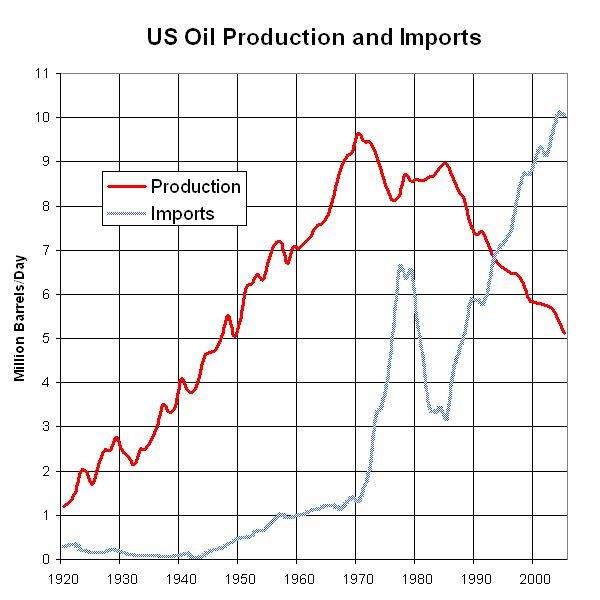
I should start this one with a caveat.  If "needs" are defined as current trends extrapolated as growing at a continuous rate into the future, then this line of thought is absolute horseshit.  American discoveries peaked around 1930 with the discovery of the West Texas fields, and around 1970 our domestic production peaked, just as legendary petroleum geologist Marion King Hubbert predicted in 1956.  Although bringing the Alaskan North Slope into full production in the 1980s helped raise production, the US never again matched its peak production of around 9.5 million bbd.
Source: Jim Quinn, "Lies We Tell Ourselves," Naked Capitalism (http://www.nakedcapitalism.com/category/auto-industry), accessed March 10, 2011.

If anyone can look at the lines on this graph and explain with a straight face why we have not exploited these numerous sources of oil even as our reliance on imports has surged again over the past 25 years, please let me know -- I have a bridge connecting two of NYC's boroughs you might be interested in....


MYTH NO. 2: It's all those greedy speculators / oil companies!
Background for dispelling this myth can be found in point no. 1, as well as the following graph showing global oil discoveries and production.

Source: ASPO-USA, "Oil Discovery" (http://www.aspousa.org/index.php/peak-oil-reference/peak-oil-data/oil-discovery/), accessed March 10, 2011.

Recall from the rebuttal to myth no. 1 the lag time between discovery peak and production peak for the United States?  Now, look at the time passed since global discovery peak on the above graph.  The simple matter is that as supply and demand of any commodity -- be it wheat, gold, or as so comically shown in the moving "Trading Places," frozen concentrated orange juice -- begin to converge, the price of that commodity becomes much more open to extreme swings through speculative investment.  As soon as speculation takes hold, the price begins to be driven more through emotion than anything else -- both on the upswing and on the downswing.  It seems that people have already forgotten how quickly the price rose to $147 per barrel and subsequently crashed into the $30s only 2-3 years ago.

MYTH NO. 3: We should open up the Strategic Petroleum Reserve!
Merriam Webster defines "strategic" as:

1 : of, relating to, or marked by strategy [strategic retreat];
2
  a : necessary to or important in the initiation, conduct, or completion of [a strategic plan];
  b : required for the conduct of war and not available in adequate quantities domestically [strategic materials];
  c : of great importance within an integrated whole or to a planned effect [strategic points];
3 : designed or trained to strike an enemy at the sources of its military, economic, or political power [strategic bomber]

Does a simple rise in the price of a commodity, no matter how precious that commodity is to conducting what we see as a "normal" life, meet any of the above definitions?  Hardly.
MYTH NO. 4: There are plenty of oil reserves out there, we just have to start pumping them.
The keys to understanding oil supplies lies not in looking at simple reserve numbers, but rather looking at production and energy return on energy invested (ERoEI).  For example, a field may contain reserves of 20 billion barrels.  But if you can only produce 100,000 barrels each day without the possibility of damaging the well (and impacting future production), then your production is only 100,000 barrels each day.  
As for ERoEI, the Canadian Tar Sands provides an excellent example.  These finds may indeed contain billions of barrels of oil equivalent.  They also take high amounts of energy to produce, with an estimated ERoEI of 5.  This means that it costs approximately 1 barrel of oil equivalent to obtain 5 barrels of oil equivalent from the tar sands.  By comparison, the West Texas fields had an ERoEI of over 50:1, in some instances approaching 100:1 (Note: I would like to provide a source for this last number, but I have read it in several places and can't readily find one with just a quick Googld search).  What this means is that although there may be a lot of potential oil in the tar sands, it also takes a tremendous amount of oil to get at it.  It's the equivalent of investing money toward the point that you only receive $1 for every $1 you put in -- at which point there's no longer any point in continuing.  Likewise, regardless of the amount of projected reserves of tar sands, the difficult process in turning them into usable oil places a cap on the possible production well below that of light, sweet crude with an ERoEI of 50:1 and upwards.

I'll leave it at those 4 for right now.  If anyone has any thoughts on this, I would appreciate hearing them.  I'll probably return to this topic again in the future as more ideas come to me. 

Wednesday, March 9, 2011

Sphere of influence vs. sphere of concern

I've become a big fan of podcasts over the past several months -- a trend driven largely by my 3-hour (sometimes more) daily commute to work.  One of my favorite podcasts has become "The Survival Podcast" with Jack Spirko (www.thesurvivalpodcast.com), even though there is at least one thing in almost every episode that I vigorously disagree with.

In several episodes, Jack has mentioned a concept from Stephen Covey's well-known book, The Seven Habits of Highly Effective People.  That concept is summarized best by the title of this post, although I believe that Covey refers to it as "circles" instead of "spheres".  There are several summaries of the concept of "influence" vs. "concern" on the internet.  Two of them can be found via these links:
https://www.stephencovey.com/7habits/7habits-habit1.php
http://www.ndoherty.com/circle-of-influence-circle-of-concern/

I used to live primarily in the circle of concern instead of the circle of influence.  And I can speak from experience, that the more time you spend there, the more frustrated you feel at your lack of influence -- and the more your circle of influence shrinks as a result, just as Covey describes.  After moving more into the circle of influence, it is amazing the feeling of empowerment I feel as compared to before -- and how I can sense my circle of influence beginning to grow and expand outward.  Or at least, that's the way that it feels to me.

So, what does all of this have to do with the Survival Podcast?  Basically, I think it has to do with the focus that we all need to have in the midst of challenging times in regards to what Chris Martenson (www.chrismartenson.com) has described as the "Three E's" -- Economy, Energy and Environment.  What I love about Spirko's focus is that it is primarily about actions that we can all take "to live that better life if times get tough, or even if they don't."

In the spirit of living that better life, here are the things that I have been concentrating on over the past couple of months:
- Reading and researching about permaculture principles of food production
- Building some cold frames to get an early start on my garden season, as well as extend the season through the fall into the winter (I already have spinach sprouting up in one of them)
- Learning about rocket mass heaters in order to design and construct one in the summer
- Organizing a showing of Chris Martenson's "Crash Course" (www.chrismartenson.com/crashcourse) at my local library, where I was able to connect with other like-minded people in my area.
- Saving money and paying off debt through the principles embodied in Joe Dominguez and Vicki Robin's book, Your Money or Your Life.
- Making sure that I spend time playing with my daughter every day if possible, even if it's after a long work day, because it always brings a smile to my face no matter how tired I might be.
- Trying (and this is still a difficult thing) to focus on the things that I can get done in the time I have, instead of lamenting how I don't have anywhere near enough time to get the things done I want to do.
- Reminding myself every day of the reasons why I love my wife -- especially when her discomfort and raging hormones of being in her seventh month of pregnancy take over.

While writing this list, I am also forced to reflect upon the first session of my showing of Chris Martenson's Crash Course.  Immediately before the event we had a short period of discussion among the attendees, and a discussion following the video that lasted for a good ninety minutes.  One of the attendees there was what I would characterize as the archetypal liberal -- a type that I know well because I used to be that kind of person.  Like most liberals (my old self included), she was driven primarily by her sphere of concern.  As an example, she stated quite unequivocally that we needed to concentrate on the issue of population above all others, that if we would only address that issue that the others would be much easier.

Now, I'm not going to disagree with the notion that stresses on our ecosystems and natural resources have a lot to do with human overpopulation.  The simple fact is that during the past 30 years we have increased from a world population of 4.5 billion to 6.5 billion, and continue to increase at a rate of over 70 million each year.  The reality, however, is that aside from my own personal actions, there is little I can do about overpopulation -- and if I concentrate on that issue as this person suggested, I will end up likely alienating more people through coming off as preachy and controlling (as this person's point of view struck me) than persuading them to my point of view.

By concentrating on my circle of influence, however, and focusing my efforts on household food production, reduced home energy usage and reducing overall consumption -- I am able to serve as an example to others, perhaps bringing them to the conclusion that such actions can help lead to a better life.  This, in turn, can compel them to voluntarily undertake those changes on their own, thus helping to reduce pressure on the systems that we all depend upon for some semblance of a modern life, while still maintaining the more important aspects of that modern life.

Also, in the spirit of living that better life by concentrating on my sphere of influence over my sphere of concern, I will be resuming (or would that be starting) more blog entries over the coming weeks and months.  I am not doing this for the sole purpose of gaining a wide audience (although I admit that would be nice) but because the process of writing all of these things down is important to my maintaining focus on the sphere of influence and letting go of those things that exist solely within my sphere of concern.  If anyone out there is reading this, I would also very much appreciate any feedback you could provide on your own thoughts on this journey.